🇨🇾 BOX NOW delivery in 5–7 working days ✅ Pay on delivery 📦 Free shipping from €50

Peptides: what they are, how they act and main categories
Peptides are short chains of amino acids that act as “signals” in the body: they bind to specific receptors and activate cellular responses (metabolism, regeneration, immunity, pigmentation, etc.). In practice they allow very targeted action — from control of appetite/glucose (GLP-1/amylin) to stimulation of the GH axis (GHRH/GHRP), tissue support (BPC-157/TB-500), neuro-support (Semax/Selank), etc. Some substances have strong clinical data and approved pharmaceutical forms (e.g. semaglutide/tirzepatide/tesamorelin), while others remain experimental and are available for research only — with corresponding regulatory labelling. In any case, quality is critical (see “Quality and purity control”).
Peptides: what they are, how they act and main categories
Peptology · 2026-06-04

Summary in a few words
Peptides are short chains of amino acids that act as “signals” in the body: they bind to specific receptors and activate cellular responses (metabolism, regeneration, immunity, pigmentation, etc.). In practice they allow very targeted action — from control of appetite/glucose (GLP-1/amylin) to stimulation of the GH axis (GHRH/GHRP), tissue support (BPC-157/TB-500), neuro-support (Semax/Selank), etc. Some substances have strong clinical data and approved pharmaceutical forms (e.g. semaglutide/tirzepatide/tesamorelin), while others remain experimental and are available for research only — with corresponding regulatory labelling. In any case, quality is critical (see “Quality and purity control”).
What are peptides?
Peptides = short chains of amino acids (usually 2–50). Proteins = long chains with complex three-dimensional structures. In humans, many hormonal/neuroendocrine mediators are peptides (GLP-1, GHRH, amylin, etc.). When synthetic analogues bind to the corresponding receptors, they activate similar intracellular pathways — hence specific, often potent, effects.
How they “work”: peptide → receptor → signalling → physiological effect
(e.g. GLP-1 → reduced appetite & better glycaemic control · GHRH/GHRP → pulsatile GH secretion · α-MSH analogues → pigmentation).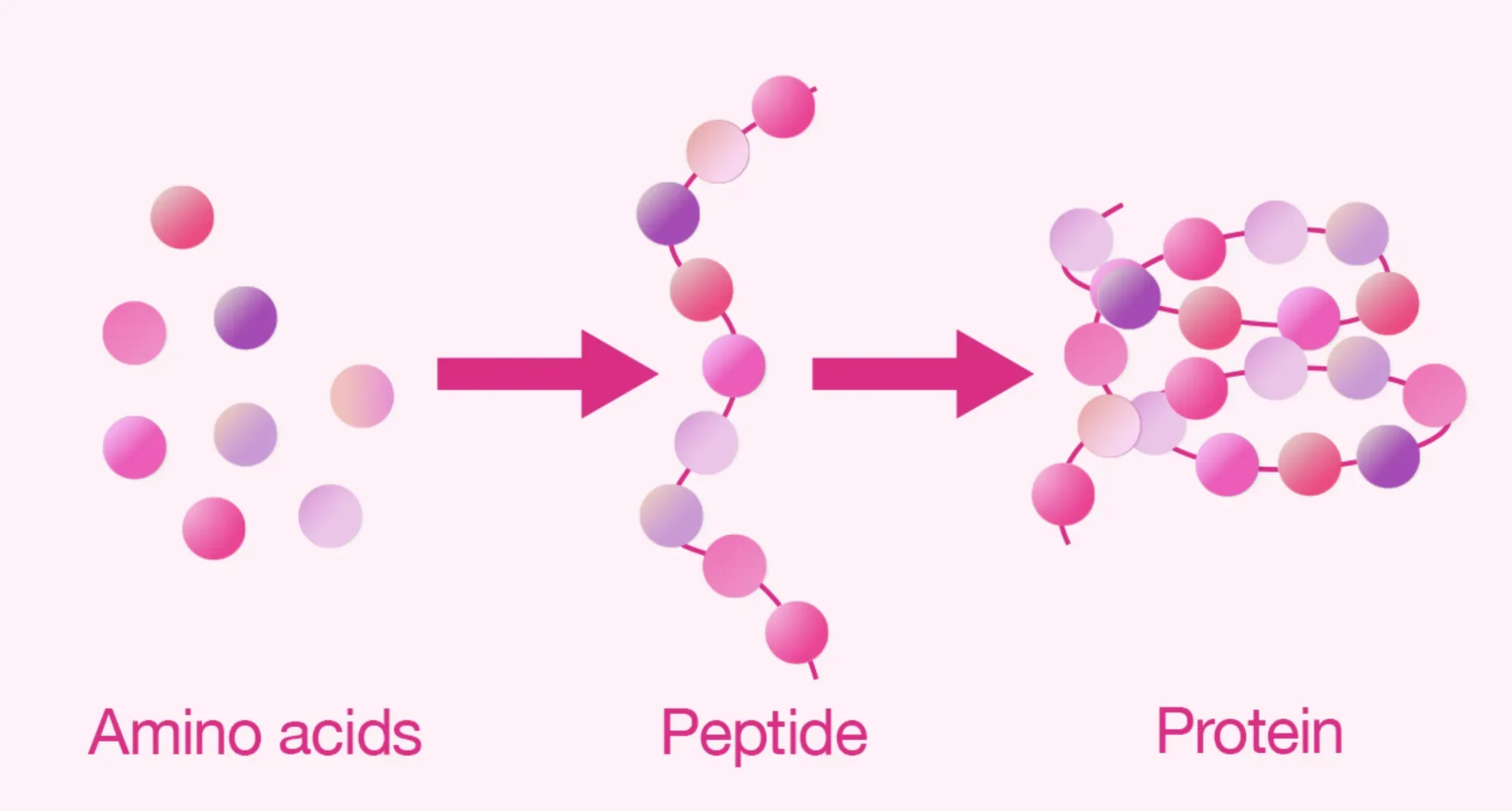
Main categories of peptides
1) Metabolic & appetite regulation (GLP-1 incretins and amylin)
-
Semaglutide 5 mg (GLP-1 agonist) — long-acting; in the approved forms it is administered once weekly. Most common adverse events (AEs): gastrointestinal (nausea, diarrhoea/constipation), usually mild to moderate.
-
Tirzepatide 5 mg (dual GLP-1/GIP agonist) — in head-to-head studies shows greater weight loss vs semaglutide; similar AE profile (mainly GI).
-
Retatrutide 5 mg (triple GLP-1/GIP/GCGR agonist) — next-generation incretin, still experimental.
-
Cagrilintide 5 mg (amylin analogue) — reduces appetite/slows gastric emptying; also studied in combination with semaglutide, where GI events are more frequent but generally mild to moderate.
-
CS10 (Cagrilintide + Semaglutide) — a ready-made combination for research use.
2) GH axis: GHRH analogues, GHRP/secretagogues & GH
-
CJC-1295 without DAC 5 mg (GHRH analogue) — enhances pulsatile GH/IGF-1 secretion; synergistic with GHRP.
-
Ipamorelin 5 mg (selective secretagogue) — stimulates GH without significant increases in cortisol/prolactin (advantage vs GHRP-6/2).
-
Tesamorelin 10 mg (GHRH analogue) — in clinical practice the medicine is indicated for visceral fat in HIV lipodystrophy; in the catalogue it is available for research.
-
Somatropin (HGH, 10–36 IU) — recombinant human growth hormone (191 AA).
3) Regeneration/recovery & skin
-
BPC-157 (5–10 mg) — often combined with TB-500 (Thymosin-β4 fragment) in BB10/BB20 and GLOW50/GLOW70 formulas (the latter also contain GHK-Cu for skin/collagen). Important for athletes: BPC-157 and TB-500 are included in WADA lists (see “Frequently asked questions”).
-
GHK-Cu 100 mg (copper tripeptide) — support for regeneration/anti-age, collagen formation.
4) Neuropeptides & nootropics
-
Semax 5 mg — an ACTH(4-7) derivative; a neuroprotective/nootropic profile is described, with limited international clinical data.
-
Selank 5 mg — anxiolytic/nootropic; reports of an effect comparable to low doses of benzodiazepines, but without typical sedation/muscle relaxation; larger studies are needed.
5) Melanocortins — pigmentation, photoprotection & libido
-
Melanotan I (MT-1) 10 mg and Melanotan II (MT-2) 10 mg — α-MSH analogues (MC1R/MC4R). Regulatory note (e.g. UK): injectable forms of melanotan are considered unapproved/illegal; risks have been reported and avoidance is advised.
-
PT-141 (Bremelanotide) 10 mg — acts on MC3R/MC4R; differs from vasoactive drugs for erectile dysfunction (central action).
6) Immune/hormone modulators (GnRH/Kisspeptin/Thymus)
-
Kisspeptin-10 5 mg and Gonadorelin 2 mg (GnRH agonist) — regulate the HPG axis (LH/FSH/testosterone).
-
Thymosin Alpha-1 5 mg and Thymulin 5 mg — immunomodulatory peptides.
-
hCG 5000 IU — technically a glycoprotein hormone, but in the catalogue it sits alongside “peptide modulators”; activates LH receptors (fertility/androgens).
How peptides act (mechanism in brief)
-
Receptor binding (GLP-1R, MC1R/MC4R, GHRH-R, GHS-R, amylin receptors, etc.).
-
Signalling (cAMP/PKA, MAPK/ERK, PI3K/AKT etc.) → “translation” of the signal inside the cell.
-
Physiological response — reduced appetite, better glycaemic control, pulsatile GH, neoangiogenesis/tissue remodelling, change in pigmentation, regulation of neurotransmitters, etc.
Quality and purity control (HPLC/MS)
In a research peptide, quality is judged by purity, the identity of the molecule and correct storage. At Peptology, every batch is tested by an independent laboratory:
Purity (HPLC): high-performance liquid chromatography shows the percentage of the main peptide in the sample; the target is purity above 99%.
Identity (MS): mass spectrometry confirms that the molecular weight corresponds to the expected molecule.
Endotoxins (LAL): for many products the certificate also includes an endotoxin test.
Certificate per batch (CoA): the batch number, date and analysis results appear on each product page and in the laboratory analyses.
Storage: lyophilised peptides are stored in the original packaging, away from light and moisture; after reconstitution at 2–8 °C.
Peptology products are intended exclusively for laboratory research and are not medicines.
Frequently asked questions (FAQ)
Peptide ≠ protein — what is the difference?
Length and structure: peptides are short “signalling” chains, proteins are large and functionally complex.
Can they be taken orally?
Most are broken down in the GI tract; that is why parenteral routes (injectable/intranasal) are often used. There are exceptions with special formulations.
Why do GLP-1s often cause nausea?
Receptor activation slows gastric emptying and reduces appetite centrally — a mechanism that explains the usual GI profile, especially during titration.
Can athletes use BPC-157/TB-500?
No — they are included in WADA's prohibited substances. Always check the updated list.
Disclaimer
The content is exclusively informational/educational and does not replace a medical opinion. Products “for research use” are not intended for human use. For any decision relating to health, consult a doctor/specialist.