🇨🇾 BOX NOW delivery in 5–7 working days ✅ Pay on delivery 📦 Free shipping from €50


BPC-157
BPC-157 5/10 mg – synthetic pentadecapeptide
Peptology Ltd. · Recovery and anabolic peptides
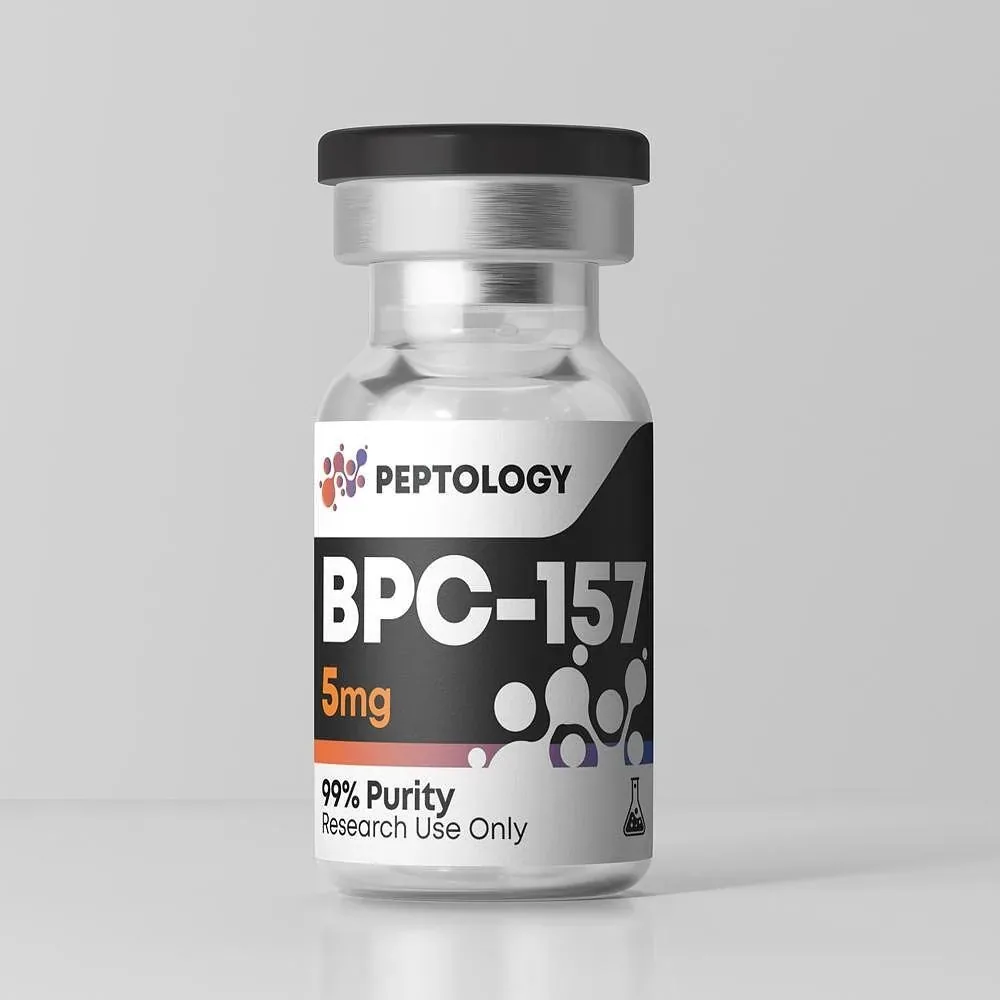
BPC-157 (BPC 157, BPC157) is a synthetic pentadecapeptide, derived from a gastric juice protein that Peptology supplies strictly for laboratory research, in 5/10 mg. You can buy BPC-157 in Cyprus online from €25.00, with same-day dispatch for orders placed by 15:00. 99%+ purity, HPLC/MS certificate for every batch, so every vial comes with documented quality data. Delivery in 5–7 working days with BOX NOW, free from €50; you pay on delivery – by card through the BOX NOW payment link, before you open the locker. The product is not intended for human or veterinary use.
25,00 € · In stock
- 5mg — 25,00 €
- 10mg — 45,00 €
For research use only / Not a medicine
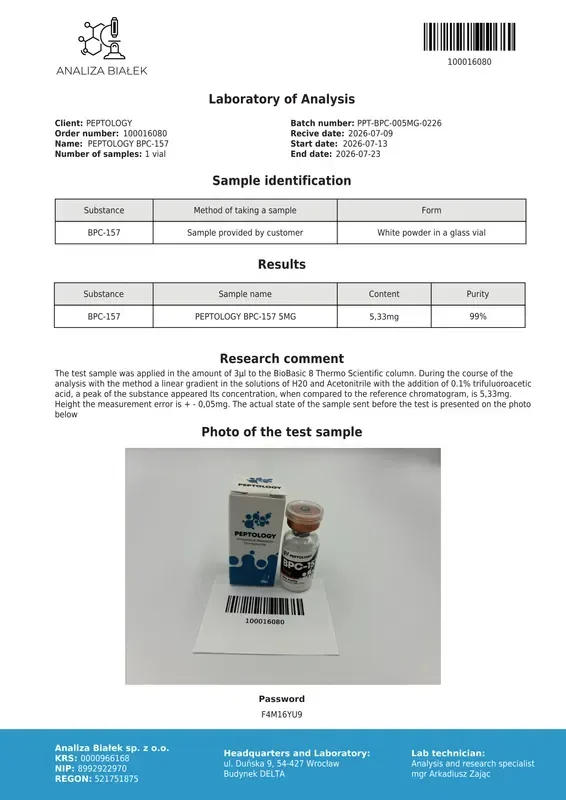
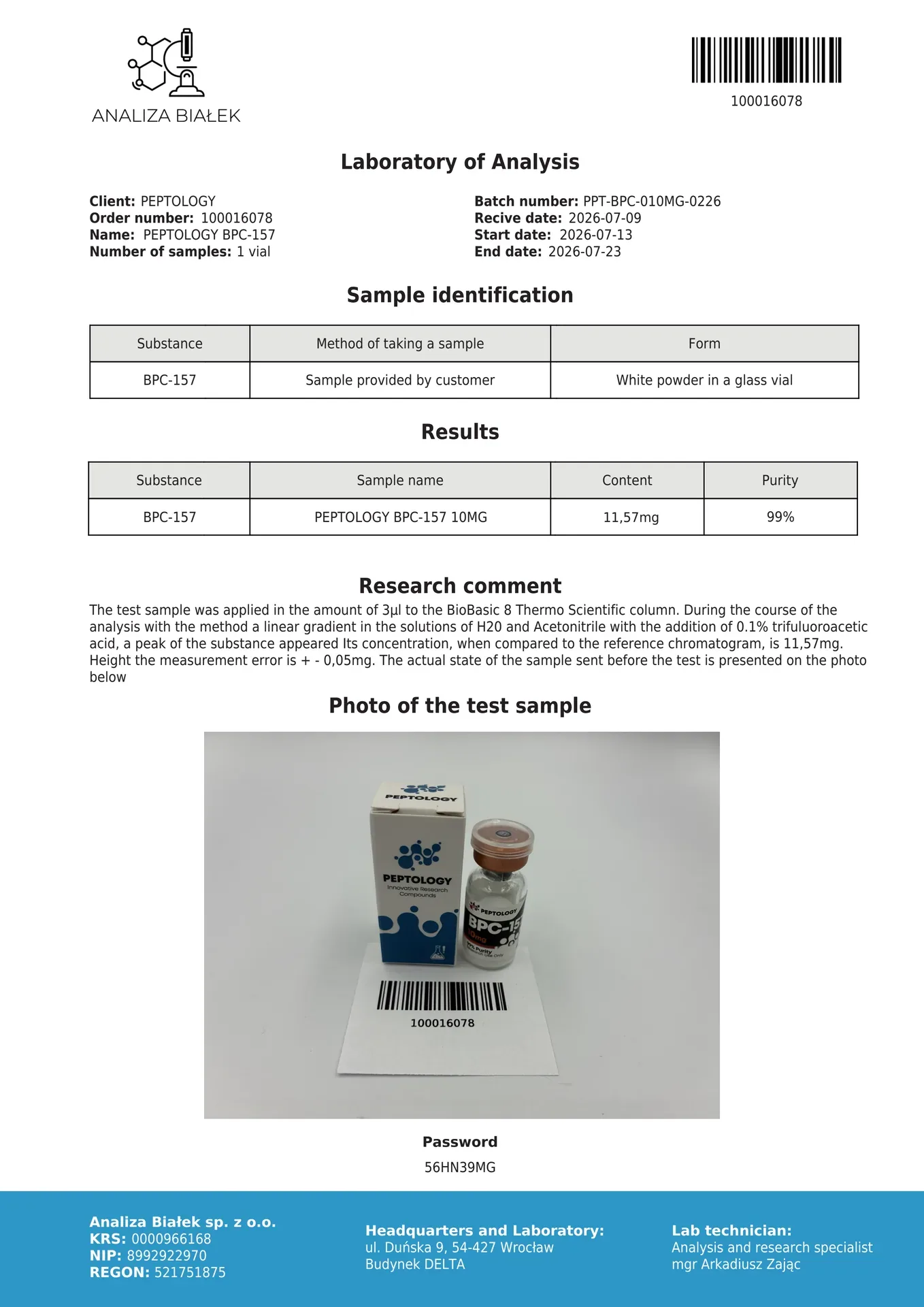
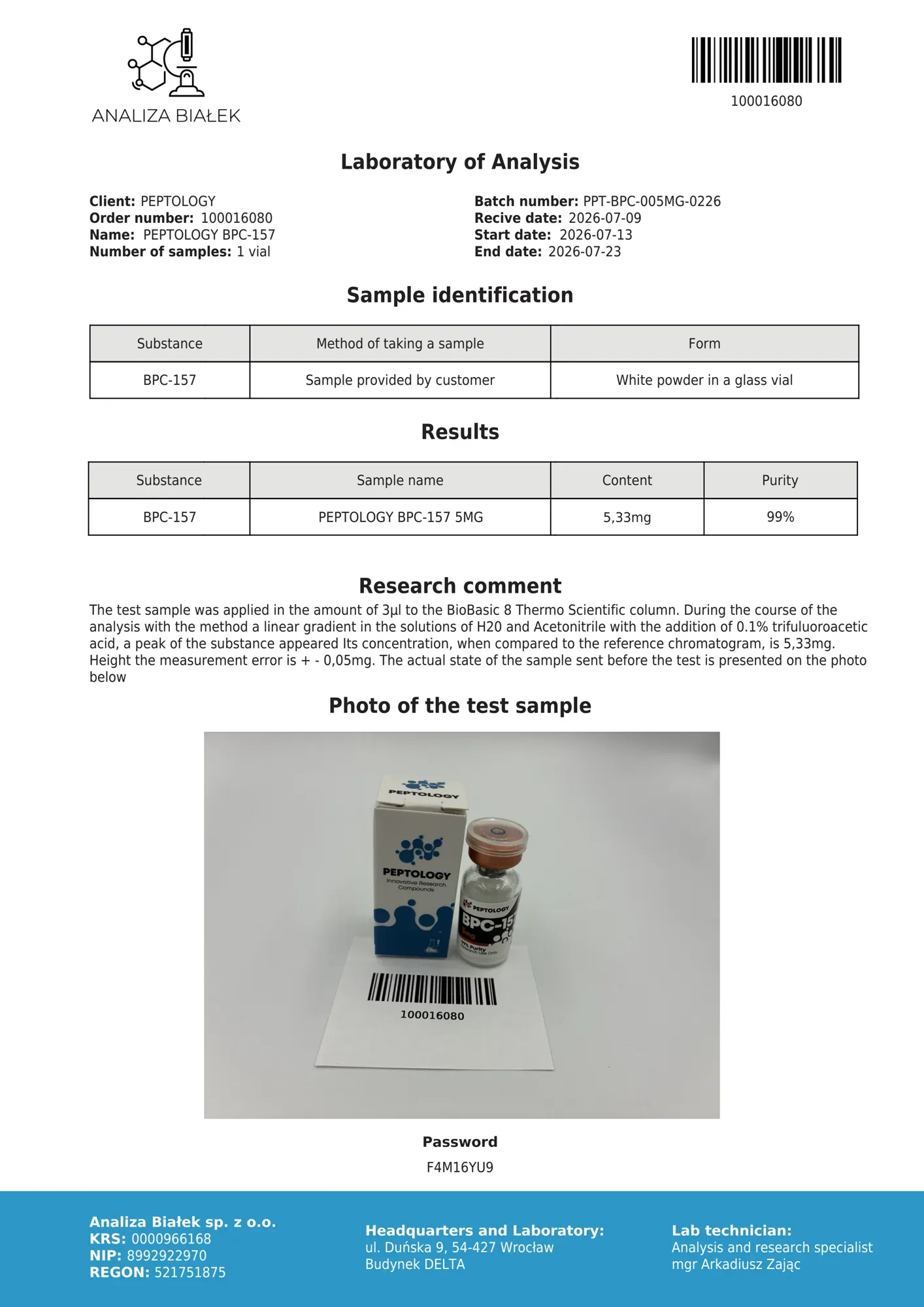
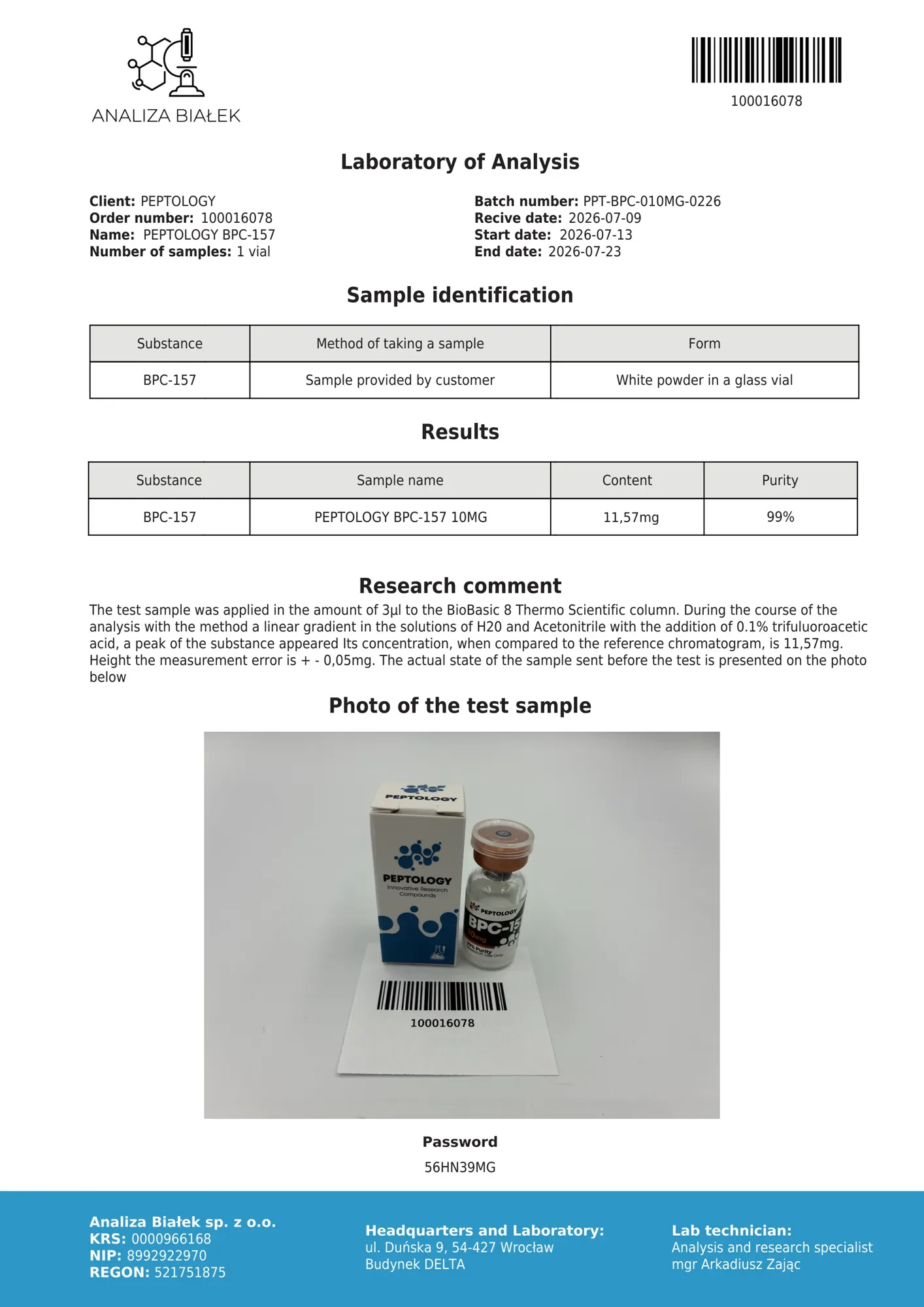
| Purity | >99% |
|---|---|
| Method | HPLC + LC/MS |
| Laboratory | Analiza Białek |
| Batch | 0226 |
Last updated: 18/10/2026
What is BPC-157?
BPC-157 (Body Protection Compound 157, pentadecapeptide BPC 157) is a synthetic peptide of 15 amino acids (pentadecapeptide), derived from a protective protein of gastric juice. It is one of the most studied regeneration peptides, with reparative and anti-inflammatory properties in a wide range of preclinical models.
Together with TB-500, BPC-157 is the “lead” peptide of the “regeneration and recovery” category. The two have complementary mechanisms — which is why they appear together in formulas such as BB20 or GLOW70.
It is studied in research for the healing of tendons, ligaments, muscles and bones, gastrointestinal repair, angiogenesis and anti-inflammatory actions. See the range in the all peptides category.
In the Peptology version, it is supplied as a lyophilised powder for research use with purity > 99%, in two forms — 5 mg and 10 mg. It is intended exclusively for scientific, research and in vitro applications — it is not a medicine and is not approved for human/veterinary use.
Available formats: 5 mg and 10 mg
5 MG
Typical form
For validation experiments and protocols of usual size.
10 MG
Extended form
For longer series and protocols with higher consumption.
Both forms have purity > 99% and a laboratory certificate for each batch. The choice depends on the scale of the protocol.
How BPC-157 acts — angiogenesis and nitric oxide
ANGIOGENESIS (VEGFR2)
It activates the VEGFR2–PI3K–Akt–eNOS pathway, promoting the formation of new vessels — the supply of oxygen and nutrients for healing.
NITRIC OXIDE (NO)
It modulates the synthesis of nitric oxide (via Akt-eNOS and Src-caveolin-1), supporting vasodilation and vessel stability.
COLLAGEN AND FIBROBLASTS
It stimulates fibroblast activity and collagen synthesis — the basis of tendon, ligament, muscle and gastrointestinal repair.
Why BPC-157 and TB-500 are “complementary”
BPC-157 acts mainly on local angiogenesis and the nitric oxide pathways (vessel formation, collagen synthesis), while TB-500 mainly affects the actin cytoskeleton and cell migration. This very complementarity explains why they are often studied together.
A particularity of BPC-157 is its stability in gastric juice, which also makes it a subject of oral studies for digestive repair. The mechanisms come from preclinical studies and are not a guarantee of the result of a research product.
Properties and pharmacology
- Structure: pentadecapeptide (15 amino acids), from a protective gastric protein
- Signalling pathways: VEGFR2–PI3K–Akt–eNOS; Src–caveolin-1–eNOS (NO)
- Actions studied: angiogenesis, collagen synthesis, fibroblasts, anti-inflammatory
- Target tissues: tendon, ligament, muscle, bone, gastrointestinal tract
- Stability: resistant to gastric juice (also studied orally)
- Status: research product, not approved; prohibited in sport (WADA)
BPC-157 vs. TB-500 vs. GHK-Cu
A comparison of BPC-157 with two other regeneration peptides in the catalogue. Reference data.
| BPC-157 | TB-500 | GHK-Cu | |
|---|---|---|---|
| Structure | Pentadecapeptide (15 aa) | Thymosin Beta-4 fragment | Copper tripeptide |
| Main mechanism | Angiogenesis, nitric oxide | Actin binding, migration | Remodelling, collagen, skin |
| Target tissue | Tendon, ligament, gut | Systemic (cell motility) | Skin and connective tissue |
| Use in stacks | Yes (with TB-500) | Yes (with BPC-157) | Yes (GLOW) |
| Status | Research (WADA-prohibited) | Research (WADA-prohibited) | Research |
Sources: preclinical literature on BPC-157, TB-500 and GHK-Cu.
Research
Healing of tendons and connective tissue
Animal studies showed accelerated healing of tendons, ligaments and muscles, attributed to the angiogenesis and collagen synthesis that BPC-157 supports.
Gastrointestinal system
Derived from a gastric protein, BPC-157 has been studied intensively for the protection and repair of the gastrointestinal mucosa, in models of ulcer and intestinal damage.
Data limitations
Despite extensive preclinical support, data in humans are extremely limited and BPC-157 is not approved by the FDA for clinical use. It is also prohibited by WADA.
Note: Scientific reference based on preclinical data. It is not medical advice or a claim for the product.
In brief — scientific profile
- Pentadecapeptide (15 aa) — from a protective gastric protein
- Promotes angiogenesis — via the VEGFR2–Akt–eNOS pathway
- Modulates nitric oxide — vasodilation and vessel stability
- Stimulates collagen and fibroblasts — repair of tendons and gut
- Complementary to TB-500 — the basis of the regeneration stacks (BB20, GLOW70)
- Research product — not approved; prohibited in sport (WADA)
Side effects and safety
The safety profile of BPC-157 in humans is not fully characterised, as the data come mainly from preclinical studies. The reactions reported are generally mild.
Common
- Injection-site reactions
- Transient fatigue
- Mild headache
Less common
- Mild nausea
- Dizziness
- Transient flushing
Precautions
- Allergic reaction / hypersensitivity
- Limited safety data in humans
- Theoretical precaution regarding angiogenesis
Since BPC-157 promotes angiogenesis, there is a theoretical precaution where the formation of new vessels is not desirable. Scientific reference, not instructions for use.
Related peptides
TB-500
Complementary recovery peptide
BB20
BPC-157 10 mg + TB-500 10 mg
GLOW70
BPC-157 + GHK-Cu + TB-500
Peptide Matrix Water™
Recommended reconstitution solvent
See: All peptides · Blog
Research warning: BPC-157 is offered exclusively for scientific, research and in vitro purposes. It is not intended for human/veterinary use, or for the diagnosis, treatment or prevention of any condition, and is not medical advice. BPC-157 is prohibited in sport (WADA).
How does it differ from TB-500?
They are complementary: BPC-157 acts on local angiogenesis and nitric oxide, TB-500 on cell migration. That is why they appear together in BB20 .
Can I combine it with other peptides?
Yes, it is often combined with TB-500, GHK-Cu or CJC-1295 for enhanced results. Always consult a specialist before combining it.
Molecule identity
| CAS number | 137525-51-0 |
|---|---|
| Molecular weight | 1419.5 g/mol |
| Molecular formula | C62H98N16O22 |
| Class | Synthetic pentadecapeptide |
| Form | Lyophilised powder in a glass vial |
| Storage | Lyophilisate: 2–8 °C, dry and protected from light · after reconstitution: 2–8 °C |
Buy BPC-157 in Cyprus – price
You can buy BPC-157 in Cyprus online from Peptology. Prices by strength:
- 5mg: €25.00
- 10mg: €45.00
Orders placed by 15:00 on working days ship the same day and are delivered in 5–7 working days with BOX NOW. Shipping costs €2 and is free from €50; you pay on delivery – by card through the BOX NOW payment link, before you open the locker.
BPC-157 5/10 mg: which strength
BPC-157 is available in: 5/10 mg.
Research protocols
Important: Reference information for research purposes — not a recommendation for use or medical advice. BPC-157 is not approved for human/veterinary use.
In the research literature, BPC-157 is studied at microgram doses, both systemically and locally:
- Doses are usually expressed in micrograms (mcg)
- Administration can be systemic (subcutaneous) or, because of its gastric stability, oral in digestive studies
- Regeneration protocols often last a few weeks
BPC-157 is often studied together with TB-500 — a combination available ready-made in BB20. The schedules come from the research literature and are not a recommendation for individual use.
Storage and reconstitution
It is supplied as a lyophilised powder in a vial (5 or 10 mg). Lyophilised, it is stable at room temperature, away from light/humidity. For reconstitution, the recommended solvent is Peptide Matrix Water™, which significantly extends the shelf life of the solution.
- Before reconstitution: room temperature, away from light/moisture; up to 24 months.
- With Peptide Matrix Water™ (recommended): refrigerator 2–8 °C up to 60 days — the best stability option.
- With bacteriostatic water: refrigerator 2–8 °C for up to 28 days. Do not re-freeze.
- Reconstitution: add the solvent slowly down the wall, without vigorous agitation.
Laboratory tip: Add Peptide Matrix Water™ to your basket — the recommended stabilising solvent for all reconstituted peptides.
Laboratory protocol — reconstitution, research protocols, storage
Standard protocol, applicable to all research peptides in the Peptology catalogue. For the concentration of the solution (mg/mL) per vial, use the peptide reconstitution calculator.
The 60-second protocol
1. SOLVENT
2. RECONSTITUTION
The solvent is added to the wall of the vial, without agitation, then wait 10–15 minutes.
3. CALCULATION
Calculator → concentration in mg/mL
4. STORAGE
+2 °C to +8 °C, up to 60 days with Peptide Matrix Water
Quick reference
| Parameter | Value |
|---|---|
| Form | Lyophilised powder |
| Solvent | Peptide Matrix Water |
| Volume for reconstitution | 1–3 mL — 3 mL maximum (capacity of the standard vial) |
| Storage before reconstitution | Room temperature, protected from direct light (refrigeration is not mandatory) |
| After reconstitution | Up to 60 days at +2 °C to +8 °C with Peptide Matrix Water |
What you will need
Precision pipette
Calibrated, 100–1000 µL — for accurate measurement of the volume of solvent added to the vial.
70% alcohol pads
Two pads — to disinfect the peptide vial and the solvent vial.
Stabilised solvent for lyophilised peptides. Why this one.
Five rules for reconstitution
| ✅ Correct | ❌ Wrong |
|---|---|
| Disinfect the stoppers and the work surface with 70% alcohol, work with gloves | Working without disinfection |
| The solvent is added slowly down the wall of the vial | Direct jet onto the powder — foaming and denaturation |
| Light swirling between the palms | Shaking — foam, on which the peptides denature |
| Wait 10–15 minutes at room temperature | Mechanical mixing or heating |
| Visual inspection: clear, without particles | Using a cloudy or coloured solution |
Calculating the concentration
⚠️ Maximum 3 mL of solvent. The standard vial does not allow a larger volume — do not exceed it during reconstitution.
- Concentration (mg/mL) = mg in the vial ÷ mL of solvent
- Volume per sample (mL) = amount per sample (mg) ÷ concentration (mg/mL)
- 1 mg/mL = 1 µg/µL · 1 mL = 1000 µL
Reconstitution per vial — solvent: Peptide Matrix Water. Concentration after addition (1 mg/mL = 1 µg/µL):
| Vial | + 1 mL | + 2 mL | + 3 mL |
|---|---|---|---|
| 5 mg | 5 mg/mL | 2.5 mg/mL | 1.67 mg/mL |
| 10 mg | 10 mg/mL | 5 mg/mL | 3.33 mg/mL |
👉 For any vial and solvent volume — use the calculator. It calculates the concentration (mg/mL, µg/µL) and the volume per sample (mL, µL).
Storage
BEFORE RECONSTITUTION
Room temperature, protected from direct light, in the original packaging. Refrigeration is not mandatory.
AFTER RECONSTITUTION
+2 °C to +8 °C, up to 60 days with Peptide Matrix Water. Discard the remainder after this period.
FREEZING
Not recommended. Freeze/thaw cycles degrade the structure of the peptide.
Four mistakes to avoid
1. Shaking for “faster dissolution”
Foam = denaturation. Only gentle swirling between the palms.
2. Unsuitable solvent
For the stability of the peptide structure, use only a sterile, purpose-designed solvent — Peptide Matrix Water is recommended.
3. Ignoring slight cloudiness
If it is not completely clear = the sample does not meet the criteria for work.
4. Removing it from the refrigerator “for an hour or two”
Short exposures add up and jeopardise stability.
Research status: All Peptology products are intended exclusively for laboratory use and research. They are not pharmaceutical products, have not been approved for human or veterinary use and do not replace medical advice. The protocol described is standard laboratory practice for working with lyophilised peptides.
How is it stored?
The lyophilised vial is stored at room temperature, away from light. After reconstitution: with Peptide Matrix Water™ — up to 60 days at 2–8 °C; with bacteriostatic water — up to 28 days.
Purity and certificate of analysis
99%+ purity, HPLC/MS certificate for every batch.
BPC 157 - 5mg - Batch - 0226 - Purity

BPC 157 - 10mg - Batch - 0226 - Purity

Shipping and payment
Orders placed by 15:00 on working days ship the same day and are delivered in 5–7 working days with BOX NOW. Shipping costs €2 and is free from €50; you pay on delivery – by card through the BOX NOW payment link, before you open the locker.
🚚 Delivery information
- Orders placed by 15:00 are dispatched the same day, delivery in 5–7 working days.
-
Shipping with BOX NOW, chosen at checkout. Free shipping from €50, otherwise €2.
Frequently asked questions about BPC-157
Where can I buy BPC-157 in Cyprus and what does it cost?
In Cyprus you can buy BPC-157 online from Peptology, from €25.00 (5mg: €25.00, 10mg: €45.00). Delivery in 5–7 working days with BOX NOW, free from €50; you pay on delivery – by card through the BOX NOW payment link, before you open the locker.
What is BPC-157 (BPC 157, BPC157)?
It is a pentadecapeptide (15 amino acids) from a protective gastric protein. It is studied as a regeneration peptide, through angiogenesis, nitric oxide and collagen synthesis.
In what form is BPC-157 available?
As a lyophilised powder in a glass vial (5/10 mg). It is reconstituted in the laboratory with Peptide Matrix Water™ or bacteriostatic water; you can work out the concentration (mg/mL) with the <a href="/page/peptide-calculator">reconstitution calculator</a>.
Which side effects have been reported in clinical studies of BPC-157?
The safety profile of BPC-157 in humans is not fully characterised, as the data come mainly from preclinical studies. The reactions reported are generally mild.
How long does delivery take and how do I pay?
Orders placed by 15:00 on working days ship the same day and are delivered in 5–7 working days with BOX NOW. Shipping costs €2 and is free from €50; you pay on delivery – by card through the BOX NOW payment link, before you open the locker.