
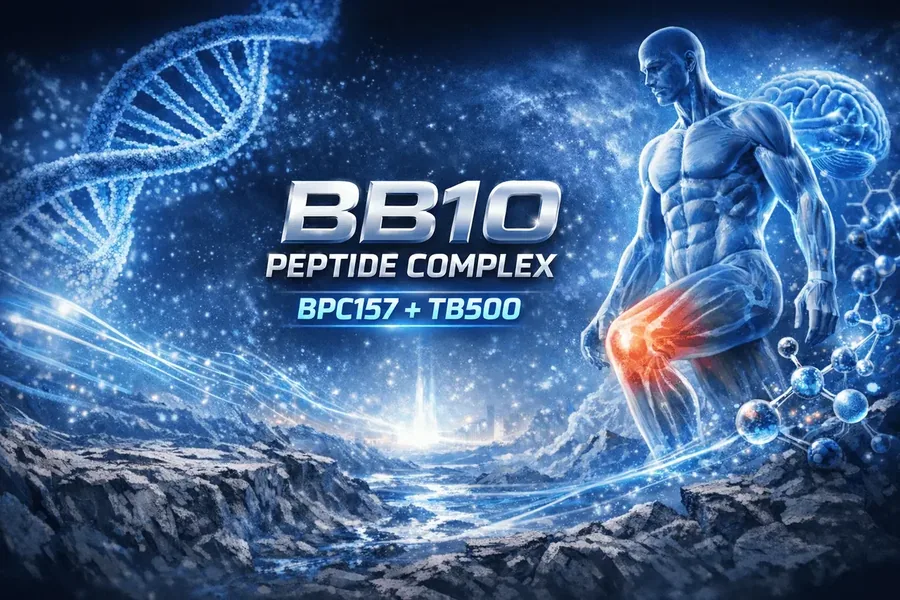
BB10 and BB20: The Synergy between BPC-157 and TB-500 in Modern Regenerative Biomedicine
A study of the combined action of Body Protective Compound and Thymosin Beta-4 for accelerated tissue repair.
1. Introduction: The evolution of combination peptide therapy
In the field of modern biotechnology and tissue engineering, research is moving further and further away from the isolated use of single molecules. The reason is the body’s complex biological response to an injury – a process that requires the simultaneous activation of multiple repair pathways.
The peptide complexes BB10 and BB20 represent the culmination of this idea. They combine two of the most potent regenerative agents known to science: BPC-157 (Body Protective Compound) and TB-500 (Thymosin Beta-4). This article will examine in detail the differences between the two concentrations, the biochemical mechanisms of action, and why their joint use is superior to isolated application in a research context.
2. Category: Peptides for cellular energy and regeneration
The BB10 and BB20 products hold a central place in the specialised Peptides for cellular energy and regeneration category. This category brings together compounds whose main mission is the optimisation of cellular metabolism and the acceleration of tissue renewal.
Here, the focus is not only on the healing of physical wounds, but also on increasing overall vitality through improved mitochondrial function and protein synthesis. These peptides act as “biochemical architects”, giving cells precise signals to switch from survival mode to a mode of active repair and energetic flourishing. In this category, the BB series is the most complete solution for “rebooting” tissues after degenerative processes or acute damage.
3. What are BB10 and BB20?
The names BB10 and BB20 denote the total quantity of active substance in a vial, in milligrams (mg), divided equally between the two peptides.
BB10 (10 mg in total)
Contains 5 mg BPC-157 and 5 mg TB-500. Ideal for moderate research protocols, injury prevention and maintaining tissue integrity under lighter loads.
BB20 (20 mg in total)
Contains 10 mg BPC-157 and 10 mg TB-500. Designed for intensive research models, where the maximum speed of regenerative response is sought in severe tissue damage, post-surgical conditions or chronic degeneration.
This precise combination saves researchers time and guarantees the perfect 1:1 ratio, which is considered the “gold standard” in synergistic protocols.
4. Biochemical profile of the components
BPC-157: The architect of angiogenesis
BPC-157 is a pentadecapeptide that in the BB10 and BB20 complexes plays the role of the “builder”. Its main mechanism includes:
- Up-regulation of VEGFR2: It stimulates the growth of new blood vessels (angiogenesis). Without new vessels, the cells in the wound area remain without oxygen and nutrients.
- Activation of fibroblasts: Fibroblasts are the cells that produce collagen. BPC-157 activates them to start the structural closure of the injured area.
- Anti-inflammatory action: It regulates the nitric oxide (NO) pathways, reducing oedema and oxidative stress in a natural way.
TB-500 (Thymosin Beta-4): The engine of cell migration
Thymosin Beta-4 is a protein that in BB10/BB20 is responsible for the “supply chain” and the “organisation”:
- G-actin binding: TB-500 binds to actin, allowing cells to literally migrate through the intercellular space towards the site of the wound.
- Stem cell differentiation: It helps convert immature cells into specialised tissue (muscle, tendon or skin).
- Prevention of fibrosis: It prevents the formation of hard substances (scars), keeping the tissue elastic and functional after healing.
5. Advantages and disadvantages of the BB series
- Maximum synergy: The combination of BPC and TB attacks the problem from two angles at once – creating a blood supply and cell migration.
- Practicality: The BB series contains both peptides in the same vial, in a 1:1 ratio.
- Minimised risk of contamination: The factory mixing requires only one reconstitution.
- Guaranteed ratio: It eliminates human error in dosing.
- Fixed ratio: Inability to change the ratio between BPC and TB according to the needs of the research.
- Sensitivity: TB-500 is a peptide that is very sensitive to vibration and temperature.
- Cold chain: Requires strict storage (2°C – 8°C).
6. Synergy mechanism: Why does 1+1 equal 3?
The main reason for the creation of BB10 and BB20 is the synchronisation of the healing phases:
- Phase 1: Signalling (TB-500) – It “marks” the injury and attracts the cells for repair.
- Phase 2: Supply (BPC-157) – It builds the capillaries through which the cells will reach the target.
- Phase 3: Repair (Together) – They create strong, elastic tissue without excessive scarring.
7. Frequently Asked Questions (FAQ)
Answer: Although it is technically feasible, it is recommended that the BB series be applied on its own to ensure the full stability of the TB-500 molecule.
Answer: When stored in the refrigerator (2°C – 8°C), BB10 and BB20 retain 95% of their activity for about 20-30 days.
Answer: The higher concentration (10mg BPC / 10mg TB) allows greater saturation of the receptors in the first, critical hours after the damage, preventing the problem from becoming chronic.
Answer: While BPC-157 is stable in the gastric environment, TB-500 breaks down immediately. Therefore, the BB series is intended exclusively for injectable research models for 100% absorption.
8. Storage and preparation instructions
- Reconstitution: Use bacteriostatic water. The liquid should be added slowly onto the walls of the vial.
- No shaking: Never shake vigorously. Homogenise with gentle circular movements.
- Temperature: After reconstitution – the refrigerator is mandatory.
9. Conclusion
The BB10 and BB20 products from the “Energy and Regeneration” category are powerful research tools. Both contain BPC-157 and TB-500 in one vial, in a 1:1 ratio. See their prices at Peptology.
Are you ready for the next level in research?
See the full category of peptides for cellular energy and regeneration.
Go to the category