
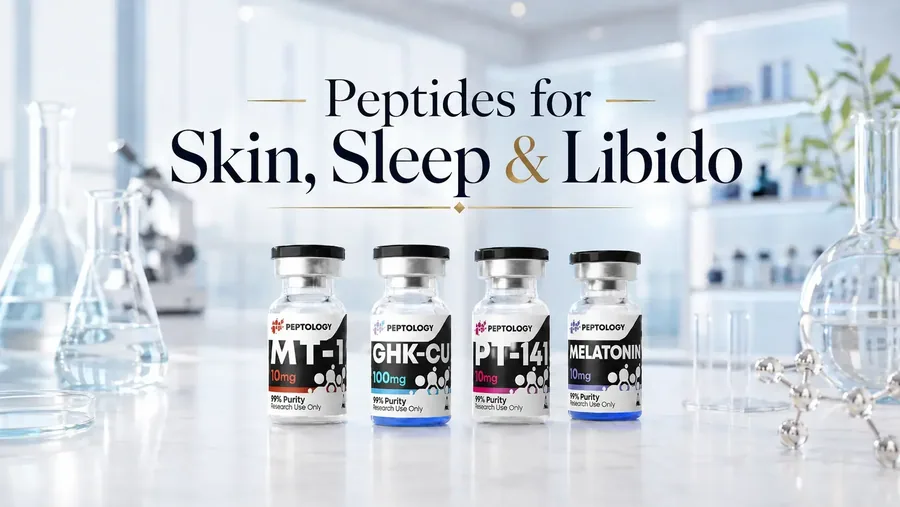
Peptides for skin, sleep and libido: complete guide to the category
A detailed overview of the three axes of this category – skin regeneration, sleep quality and sexual function. We examine the mechanisms, the main peptides and how to combine them in research protocols.
The Peptides for skin, sleep and libido category brings together a group of research peptides that at first glance seem unrelated, but in fact share a common theme – the restoration and regulation of basic physiological functions. Skin, sleep and sexual function are controlled by overlapping signalling systems: melanocortin receptors, circadian regulators, neuropeptides and tissue regeneration factors. This is why many researchers examine these three axes together. This article systematises the main peptides in the category – from GHK-Cu for the skin, through DSIP and Melatonin for sleep, to PT-141 for libido – and explains the mechanisms, applications and principles of combination. All products have purity above 99%, confirmed by independent laboratory analysis (CoA) for every batch.
1. Peptides for skin, hair and regeneration
The first axis of the category targets skin regeneration, collagen synthesis, hair growth and the slowing of biological ageing. Here copper peptides and tetrapeptides acting on cell renewal take the lead.
GHK-Cu – collagen and regeneration
GHK-Cu is a potent copper tripeptide linked to the strengthening of collagen and elastin and to the remodelling of the extracellular matrix. It is studied for fine wrinkles, skin texture, wound healing and hair growth, as well as for shifting gene expression towards a more “youthful” metabolic profile.
AHK-Cu – hair and scalp
AHK-Cu is a copper tripeptide focused on hair growth and the vascularisation of the follicles, as well as skin regeneration. It is often regarded as complementary to GHK-Cu in dermatological and trichological research models.
Epithalon – cell renewal
Epithalon is a tetrapeptide acting on telomerase and telomeres. It is studied in the context of anti-aging, antioxidant protection and DNA repair – which is why it falls under both the “skin” and the “sleep” axis.
For skin pigmentation, the key players are the melanocortin peptides MT-1 (Melanotan I) and MT-2 (Melanotan II) – analogues of α-MSH that stimulate the synthesis of eumelanin (the photoprotective pigment) through the MC1R receptor. They are analysed in the section on libido, since MT-2 also acts on sexual function.
2. Peptides for sleep and the circadian rhythm
The second axis includes peptides and regulators studied for sleep quality, the deep NREM phases, the circadian rhythm and the stress-cortisol axis. Here, the leading pair is DSIP and Melatonin.
DSIP – deep sleep
DSIP 5 mg (Delta Sleep-Inducing Peptide) is a neuropeptide studied for the NREM phase, deep sleep, fatigue and cortisol regulation. In models it is linked to relaxation and a reduced stress response.
Melatonin – circadian clock
Melatonin 10 mg is a classic regulator of the circadian rhythm through the MT1/MT2 receptors. It is studied in models of jet lag, night work and disorders of sleep onset, and as an antioxidant that supports cell renewal.
The relationship between sleep and anti-aging makes Epithalon a natural third participant on this axis – it is studied for regulating the body’s own melatonin secretion and improving the circadian rhythm. This is why, in research protocols, DSIP, Melatonin and Epithalon are often examined together as a complex for sleep and recovery.
3. Peptides for libido and sexual function
The third axis is linked to the melanocortin system in the central nervous system, which regulates sexual desire and arousal. Here the main peptides are PT-141 and MT-2.
PT-141 – focused on libido
PT-141 (Bremelanotide) targets mainly the MC3R/MC4R receptors in the brain. It is studied for hypoactive sexual desire disorder (HSDD), sexual desire and the neuronal regulation of arousal in both sexes. Unlike vasodilators, it acts centrally.
MT-2 – broad-spectrum
MT-2 (Melanotan II) is a pan-melanocortin agonist – besides the intense pigmentation (tanning), it also activates MC4R, hence the effects on libido and appetite. This makes it a “two-way” peptide for skin and sexual function.
The historical relationship between the two is significant: PT-141 is a rationally optimised metabolite of MT-2, developed to isolate the effect on libido, without the intense melanogenic action. If the goal is pure pigmentation without central effects, the selective MT-1 (Melanotan I) is more suitable. The category also includes mood neuropeptides such as Selank and Oxytocin, which are studied for the relationship between anxiety, social bonding and sexual function.
4. Table: the main peptides in the category
| Peptide | Main axis | Receptor / mechanism | Studied for |
|---|---|---|---|
| GHK-Cu | Skin | Copper peptide, collagen synthesis | Wrinkles, healing, hair |
| AHK-Cu | Skin / hair | Copper tripeptide | Hair growth, regeneration |
| Epithalon | Skin / sleep | Telomerase / telomeres | Anti-aging, circadian rhythm |
| DSIP | Sleep | Neuropeptide, NREM | Deep sleep, stress, fatigue |
| Melatonin | Sleep | MT1/MT2 receptors | Jet lag, sleep onset |
| MT-1 | Skin | Selective MC1R | Pigmentation, photoprotection |
| MT-2 | Skin / libido | Pan-melanocortin | Tanning + libido + appetite |
| PT-141 | Libido | MC3R / MC4R (CNS) | HSDD, sexual function |
The data are provided as a scientific reference and are based on published literature. They are not a claim about the effect of the research-grade products, nor a recommendation for use in humans.
5. Which peptide for which goal
The choice of peptide depends on the specific research goal, within the three axes:
For skin and regeneration: when the emphasis is on collagen, texture and healing, GHK-Cu takes the lead; for hair growth, AHK-Cu is added. For controlled pigmentation without central effects, the selective MT-1 is suitable, while for more intense and rapid tanning – MT-2.
For sleep and recovery: for the deep NREM phases, DSIP is studied, and for regulating sleep onset and the circadian rhythm – Melatonin. Epithalon links sleep with anti-aging through its effect on melatonin regulation.
For libido and sexual function: for a focused effect on desire, PT-141 is more suitable; if the study also includes pigmentation, the broad-spectrum MT-2 is used. Combining peptides from different axes (e.g. GHK-Cu + DSIP + PT-141) is common in complex protocols, but requires careful planning of doses and storage.
6. Advantages and parameters
- Covers three interconnected axes – skin, sleep and libido – with the possibility of combining them.
- Well-documented mechanisms (melanocortin system, telomerase, circadian receptors).
- All products have purity above 99% and independent laboratory analysis (CoA).
- Online purchase in Cyprus, with discreet and fast shipping.
- Strengths of 10 mg / 50 mg for research protocols of different sizes.
- Melanocortin peptides (MT-1, MT-2) require dermatological monitoring of moles.
- MT-2 has a broader profile of adverse effects (nausea, hyperpigmentation).
- Exact dosing and reconstitution are critical for reliable results.
- The products are exclusively for research use – they are not medicines or supplements.
7. Reconstitution and storage
Most peptides in the category are supplied as a lyophilised powder and require precise reconstitution for reliable results:
- Solvent: Peptide Matrix Water™ from the Peptide Solutions category is recommended – a stabilising solution that extends the shelf life of the reconstituted peptide. It is added slowly along the wall of the vial, without shaking.
- Storage after reconstitution: 2°C to 8°C, up to 60 days with Peptide Matrix Water™. Avoid direct light and re-freezing.
- Dose calculation: for exact IU in any vial and volume, use the peptide reconstitution calculator.
Explore the whole category of peptides for skin, sleep and libido
All peptides have purity above 99% and independent laboratory analysis for every batch, with discreet shipping to Cyprus. See the prices and buy online.
Go to the category at Peptology8. Conclusion
The “skin, sleep and libido” category shows how seemingly different functions of the body are regulated by overlapping peptide systems. GHK-Cu and Epithalon cover the regeneration and anti-aging axis; DSIP and Melatonin – sleep and the circadian rhythm; and PT-141, MT-2 and MT-1 – libido and pigmentation. The right choice depends on the specific research goal. At Peptology we strive to offer excellent quality and transparent prices for all your projects in this field.