🇨🇾 BOX NOW delivery in 5–7 working days ✅ Pay on delivery 📦 Free shipping from €50


NAD+
NAD+ 1000 mg – NAD coenzyme
Peptology Ltd. · Peptides for energy and regeneration
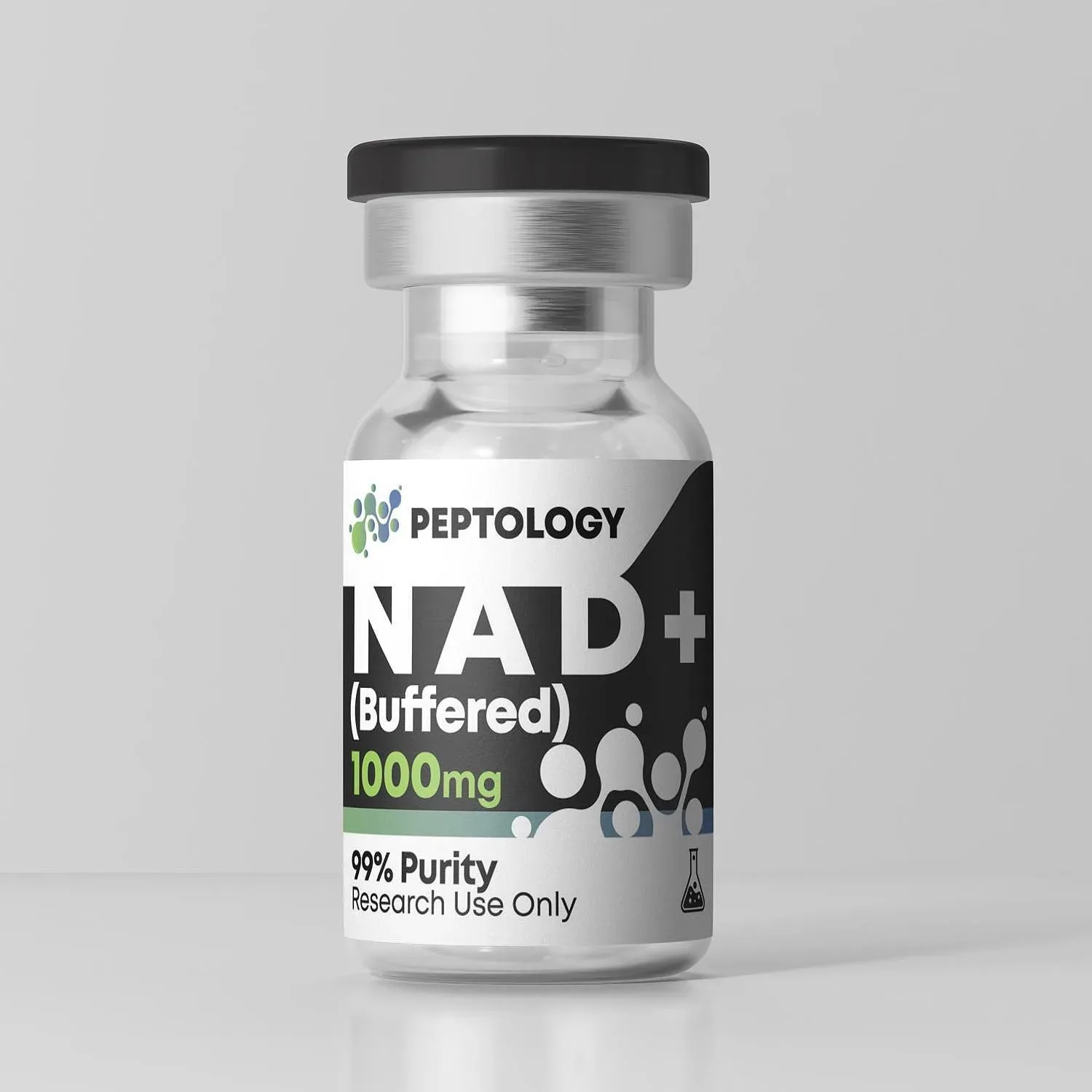
NAD+ is a coenzyme nicotinamide adenine dinucleotide that Peptology supplies strictly for laboratory research, in 1000 mg. You can buy NAD+ in Cyprus online from €89.00, with same-day dispatch for orders placed by 15:00. 99%+ purity, HPLC/MS certificate for every batch, so every vial comes with documented quality data. Delivery in 5–7 working days with BOX NOW, free from €50; you pay on delivery – by card through the BOX NOW payment link, before you open the locker. The product is not intended for human or veterinary use.
89,00 € · In stock
For research use only / Not a medicine
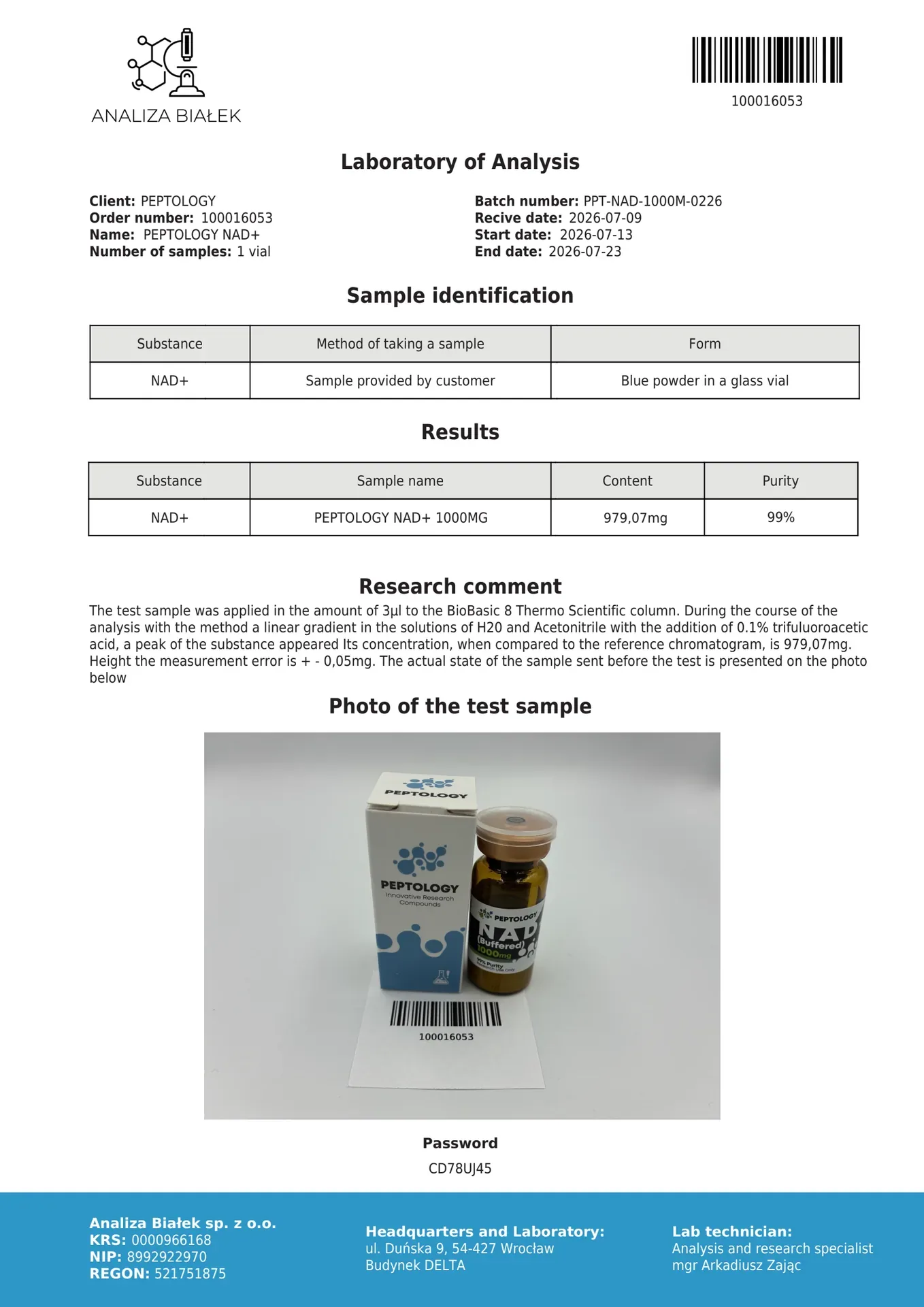
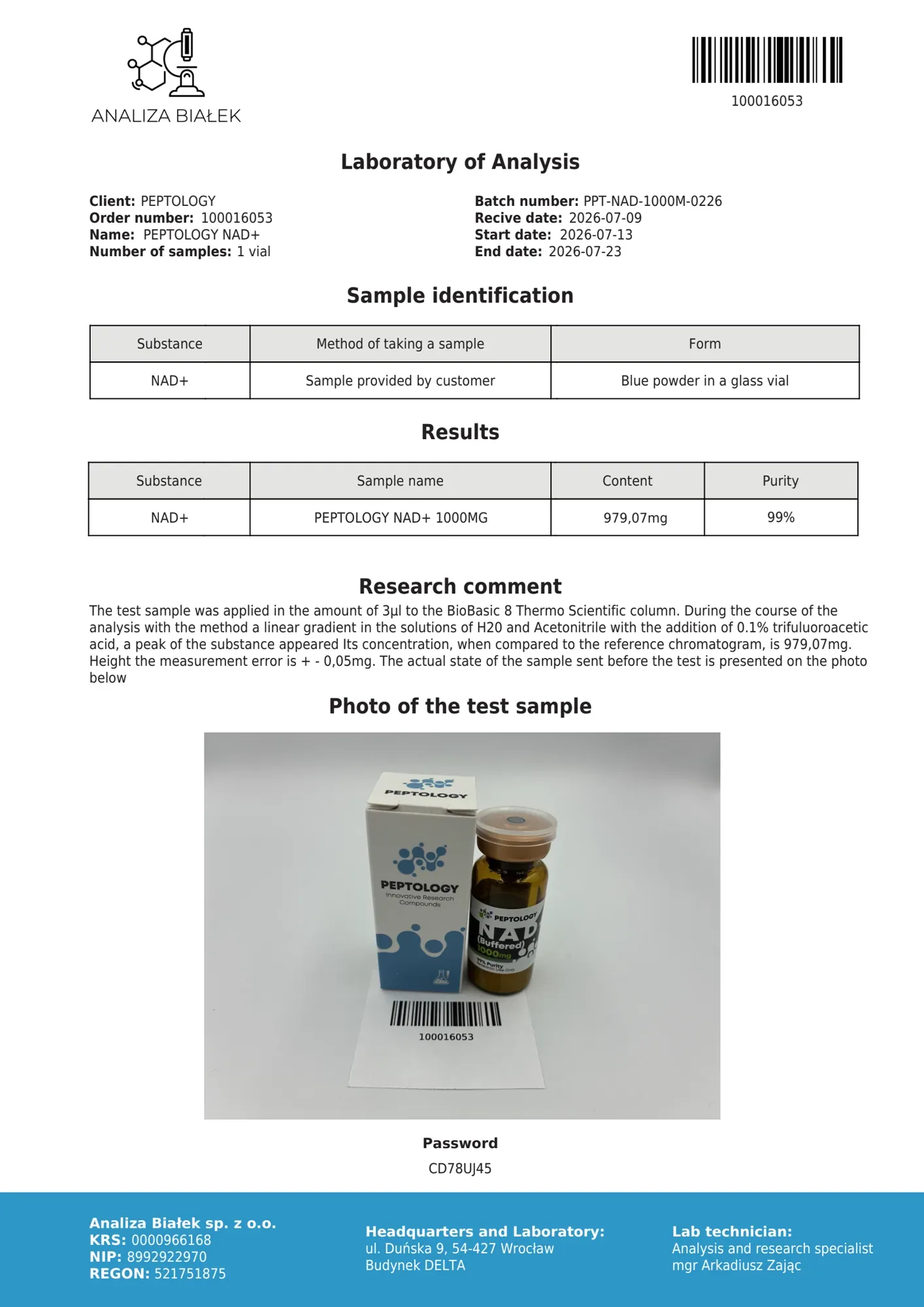
| Purity | >99% |
|---|---|
| Method | HPLC + LC/MS |
| Laboratory | Analiza Białek |
| Batch | 0226 |
Last updated: 18/10/2026
What is NAD+?
NAD+ (nicotinamide adenine dinucleotide) is a key redox cofactor — a coenzyme present in every living cell and essential for energy production. Unlike the peptides in the catalogue, NAD+ is not a peptide but a dinucleotide, which participates directly in energy metabolism, in DNA repair and in the activation of sirtuins (“longevity” enzymes).
NAD+ levels decline with ageing, which has made it a central point of anti-ageing research. The restoration of NAD+ is studied as an approach to support mitochondrial function and cellular energy — complementary to mitochondrial peptides such as SS-31 or MOTS-c.
It is studied in research for energy metabolism and mitochondria, ageing and sirtuins, DNA repair (PARP enzymes) and neurological function. See the range in the all products category.
In the Peptology version, NAD+ is supplied as a lyophilised powder for research use (buffered form) with high purity, in a generous 1000 mg format. It is intended exclusively for scientific, research and in vitro applications — it is not a medicine and is not approved for human/veterinary use.
Available form: 1000 mg (buffered)
A large-volume 1000 mg (1 g) vial, since NAD+ is used at doses much larger than typical peptides (milligrams, not micrograms). The buffered form has an adjusted pH for gentler use.
1000 MG
Large-volume vial
1 gram — for research protocols at milligram doses.
BUFFERED
Batch certificate
Adjusted pH; independent laboratory analysis per batch.
How NAD+ acts — redox cofactor
ENERGY (REDOX)
It carries electrons in the redox reactions of metabolism, essential for ATP production in the mitochondria.
SIRTUINS
It is the substrate of the sirtuins — enzymes linked to longevity that regulate metabolism, inflammation and gene expression depending on NAD+.
DNA REPAIR (PARP)
It fuels the PARP enzymes, which are involved in DNA repair — a consumption that increases with wear and age.
Why NAD+ declines with age — and why it matters
With ageing, NAD+ levels decline, partly because demand (DNA repair, inflammation) increases while production decreases. Less NAD+ means less efficient mitochondria, less active sirtuins and a reduced repair capacity. That is why the restoration of NAD+ is one of the most studied directions of ageing research.
The mechanisms come from preclinical and fundamental studies and are not a guarantee of the result of a research product.
Properties and specifications
- Molecule type: dinucleotide (redox cofactor), not a peptide
- Key roles: energy metabolism (redox), sirtuins, DNA repair (PARP)
- Characteristic: levels decline with ageing
- Form: 1000 mg (1 g) vial, buffered
- Molecular weight: 663.4 g/mol
- Status: research product (in some regions it is available as a supplement)
NAD+ vs. MOTS-c vs. SS-31 — approaches to cellular energy
A comparison of three approaches to energy and mitochondrial health in the catalogue. Reference data.
| NAD+ | MOTS-c | SS-31 | |
|---|---|---|---|
| Molecule type | Cofactor (dinucleotide) | Mitochondrial peptide | Tetrapeptide |
| Main mechanism | Redox / sirtuins / PARP | AMPK activation | Cardiolipin binding |
| Focus | Energy / DNA repair | Metabolism / glucose | ATP ↑ / ROS ↓ |
| Molecular weight | 663.4 g/mol | 2174.6 g/mol | 639.8 g/mol |
| Status | Research / supplement | Research | Research |
Sources: literature on NAD+ metabolism, sirtuins and mitochondrial biology.
Research
Metabolism and mitochondria
NAD+ is essential in glycolysis, the Krebs cycle and the electron transport chain. Its restoration is studied as an approach to support mitochondrial function and cellular energy.
Sirtuins and ageing
As the substrate of the sirtuins, NAD+ is linked to the mechanisms of longevity and the response to metabolic stress. Research in the field is very active.
Data limitations
Although the biological roles of NAD+ are well documented, the clinical efficacy of supplementation (especially of NAD+ itself versus precursor forms) and bioavailability remain subjects of active research.
Note: Scientific reference based on published data. It is not medical advice or a claim about the product.
In brief — scientific profile
- Key redox cofactor — a dinucleotide, not a peptide
- Fuel for energy production — redox, mitochondrial ATP
- Substrate of the sirtuins — enzymes linked to longevity
- Fuels DNA repair (PARP) — a system that consumes NAD+
- Declines with age — the reason for the interest in ageing research
- Generous 1000 mg format — for milligram doses
Side effects and safety
NAD+ is an endogenous molecule; many of the reactions reported relate to rapid administration, not to toxicity.
Common
- Sensation of pressure/discomfort (rapid administration)
- Injection-site reactions
- Flushing
Less common
- Nausea
- Abdominal cramps
- Headache
Precautions
- Allergic reaction / hypersensitivity
- Discomfort increases with the speed of administration
- For in vitro / laboratory use only
Most of the effects reported relate to the speed of administration and decrease with slow titration. Scientific reference, not instructions for use.
Related products
MOTS-c
Mitochondrial peptide (AMPK)
SS-31
Mitochondrial tetrapeptide
Peptide Matrix Water™
Stabilising solvent
Bacteriostatic water
Typical reconstitution solvent
See: All products · Blog
Research warning: NAD+ is offered exclusively for scientific, research and in vitro purposes. It is not intended for human/veterinary use, or for the diagnosis, treatment or prevention of any condition, and is not medical advice.
Can NAD+ be combined with other peptides or coenzymes?
Yes – it is often combined with NR, NMN, BPC-157 or resveratrol for a synergistic action.
Molecule identity
| CAS number | 53-84-9 |
|---|---|
| Molecular weight | 663.4 g/mol |
| Molecular formula | C21H27N7O14P2 |
| Class | Coenzyme (nicotinamide adenine dinucleotide) |
| Form | Lyophilised powder in a glass vial |
| Storage | Lyophilisate: 2–8 °C, dry and protected from light · after reconstitution: 2–8 °C |
Buy NAD+ in Cyprus – price
You can buy NAD+ in Cyprus online from Peptology. Prices by strength:
- NAD+: €89.00
Orders placed by 15:00 on working days ship the same day and are delivered in 5–7 working days with BOX NOW. Shipping costs €2 and is free from €50; you pay on delivery – by card through the BOX NOW payment link, before you open the locker.
NAD+ 1000 mg: which strength
NAD+ is available in: 1000 mg.
Research protocols
Important: Reference information for research purposes — not a recommendation for use or medical advice. NAD+ is not an approved medicine.
Unlike peptides, NAD+ is used at milligram doses:
- Research doses are on the milligram scale (much larger than typical peptides)
- Rapid administration is often associated with discomfort — which is why buffered forms and slow titration are preferred
- Protocols are often run in cycles
NAD+ is sometimes studied together with mitochondrial peptides such as SS-31 or MOTS-c. The schedules come from the research literature and are not a recommendation for individual use.
Storage and reconstitution
Supplied as a lyophilised powder in a 1000 mg vial. NAD+ is a relatively sensitive molecule; in lyophilised form it is stored away from light, moisture and heat (preferably in the refrigerator for prolonged storage). After reconstitution, the solution is stored in the refrigerator.
- Before reconstitution: away from light/moisture; for prolonged storage, in the refrigerator.
- After reconstitution: refrigerator 2–8 °C and use within a short period; NAD+ is less stable in solution than lyophilised peptides.
- Solvent: bacteriostatic water or sterile water can be used; the large volume of powder requires a proportionate volume of solvent.
- Reconstitution: add the solvent slowly down the wall; swirl gently until fully dissolved.
- Re-freezing: not recommended.
Technical note: NAD+ is not a peptide but a cofactor — its sensitivity to light, heat and pH makes rapid use and refrigerated storage particularly important.
Laboratory protocol — reconstitution, research protocols, storage
Standard protocol, applicable to all research peptides in the Peptology catalogue. For the concentration of the solution (mg/mL) per vial, use the peptide reconstitution calculator.
The 60-second protocol
1. SOLVENT
2. RECONSTITUTION
The solvent is added to the wall of the vial, without agitation, then wait 10–15 minutes.
3. CALCULATION
Calculator → concentration in mg/mL
4. STORAGE
+2 °C to +8 °C, up to 60 days with Peptide Matrix Water
Quick reference
| Parameter | Value |
|---|---|
| Form | Lyophilised powder |
| Solvent | Peptide Matrix Water |
| Volume for reconstitution | 1–3 mL — 3 mL maximum (capacity of the standard vial) |
| Storage before reconstitution | Room temperature, protected from direct light (refrigeration is not mandatory) |
| After reconstitution | Up to 60 days at +2 °C to +8 °C with Peptide Matrix Water |
What you will need
Precision pipette
Calibrated, 100–1000 µL — for accurate measurement of the volume of solvent added to the vial.
70% alcohol pads
Two pads — to disinfect the peptide vial and the solvent vial.
Stabilised solvent for lyophilised peptides. Why this one.
Five rules for reconstitution
| ✅ Correct | ❌ Wrong |
|---|---|
| Disinfect the stoppers and the work surface with 70% alcohol, work with gloves | Working without disinfection |
| The solvent is added slowly down the wall of the vial | Direct jet onto the powder — foaming and denaturation |
| Light swirling between the palms | Shaking — foam, on which the peptides denature |
| Wait 10–15 minutes at room temperature | Mechanical mixing or heating |
| Visual inspection: clear, without particles | Using a cloudy or coloured solution |
Calculating the concentration
⚠️ Maximum 3 mL of solvent. The standard vial does not allow a larger volume — do not exceed it during reconstitution.
- Concentration (mg/mL) = mg in the vial ÷ mL of solvent
- Volume per sample (mL) = amount per sample (mg) ÷ concentration (mg/mL)
- 1 mg/mL = 1 µg/µL · 1 mL = 1000 µL
👉 For any vial and solvent volume — use the calculator. It calculates the concentration (mg/mL, µg/µL) and the volume per sample (mL, µL).
Storage
BEFORE RECONSTITUTION
Room temperature, protected from direct light, in the original packaging. Refrigeration is not mandatory.
AFTER RECONSTITUTION
+2 °C to +8 °C, up to 60 days with Peptide Matrix Water. Discard the remainder after this period.
FREEZING
Not recommended. Freeze/thaw cycles degrade the structure of the peptide.
Four mistakes to avoid
1. Shaking for “faster dissolution”
Foam = denaturation. Only gentle swirling between the palms.
2. Unsuitable solvent
For the stability of the peptide structure, use only a sterile, purpose-designed solvent — Peptide Matrix Water is recommended.
3. Ignoring slight cloudiness
If it is not completely clear = the sample does not meet the criteria for work.
4. Removing it from the refrigerator “for an hour or two”
Short exposures add up and jeopardise stability.
Research status: All Peptology products are intended exclusively for laboratory use and research. They are not pharmaceutical products, have not been approved for human or veterinary use and do not replace medical advice. The protocol described is standard laboratory practice for working with lyophilised peptides.
Why such a large vial (1000 mg)?
Because NAD+ is used at milligram doses, much larger than typical peptides (which are used in micrograms). A 1 g vial covers extended protocols.
How is it stored?
Away from light, moisture and heat; for prolonged storage, in the refrigerator. After reconstitution it is stored at 2–8 °C and used soon, as it is less stable in solution.
Purity and certificate of analysis
99%+ purity, HPLC/MS certificate for every batch.
NAD+ (Buffered) - 1000 mg - Batch - 0226 - Purity

Shipping and payment
Orders placed by 15:00 on working days ship the same day and are delivered in 5–7 working days with BOX NOW. Shipping costs €2 and is free from €50; you pay on delivery – by card through the BOX NOW payment link, before you open the locker.
🚚 Delivery information
- Orders placed by 15:00 are dispatched the same day, delivery in 5–7 working days.
-
Shipping with BOX NOW, chosen at checkout. Free shipping from €50, otherwise €2.
Frequently asked questions about NAD+
Where can I buy NAD+ in Cyprus and what does it cost?
In Cyprus you can buy NAD+ online from Peptology, from €89.00. Delivery in 5–7 working days with BOX NOW, free from €50; you pay on delivery – by card through the BOX NOW payment link, before you open the locker.
What is NAD+?
It is a key redox cofactor, present in all cells. It participates in energy metabolism, in the activation of sirtuins and in DNA repair. It is not a peptide.
In what form is NAD+ available?
As a lyophilised powder in a glass vial (1000 mg). It is reconstituted in the laboratory with Peptide Matrix Water™ or bacteriostatic water; you can work out the concentration (mg/mL) with the <a href="/page/peptide-calculator">reconstitution calculator</a>.
Which side effects have been reported in clinical studies of NAD+?
NAD+ is an endogenous molecule; many of the reactions reported relate to rapid administration, not to toxicity.
How long does delivery take and how do I pay?
Orders placed by 15:00 on working days ship the same day and are delivered in 5–7 working days with BOX NOW. Shipping costs €2 and is free from €50; you pay on delivery – by card through the BOX NOW payment link, before you open the locker.