
NAD+ in research: cellular energy, DNA repair and mitochondria
NAD+ (nicotinamide adenine dinucleotide) is a coenzyme found in every cell. In its oxidised form it accepts electrons and becomes NADH, and it is also a substrate for sirtuins and the PARP enzymes. Below: structure, role in the mitochondria and the difference from NMN and NR in the literature.
What is NAD+?
NAD+ (Nicotinamide Adenine Dinucleotide) is a dinucleotide: two nucleotides – one based on nicotinamide and one based on adenine – joined by a bridge of two phosphate groups. Its chemical formula is C21H27N7O14P2, with a molecular weight of approximately 663.4 g/mol (CAS 53-84-9).
NAD+ is present in all living cells, in the cytoplasm, the nucleus and the mitochondria. It is not a peptide but a coenzyme; in the Peptology catalogue it is in the Peptides for energy and regeneration category, together with molecules studied in cellular metabolism.
NAD+ and NADH: the redox form
In metabolism, NAD+ acts as an electron carrier. In glycolysis, the citric acid cycle and the β-oxidation of fatty acids it accepts a hydride ion (two electrons and one proton) and is reduced to NADH. NADH carries the electrons to complex I of the mitochondrial respiratory chain, where their flow is coupled to ATP synthesis, and so NAD+ is regenerated.
The NAD+/NADH ratio is used in the literature as an indicator of the redox state of the cell. The phosphorylated form, NADP+/NADPH, takes part mainly in biosynthetic reactions and in antioxidant defence.
NAD+, NMN and NR: what is the difference?
NMN (nicotinamide mononucleotide) and NR (nicotinamide riboside) are not NAD+, but precursor compounds: the cell converts them into NAD+ through the “salvage pathway”. NR is phosphorylated by NRK kinases to NMN, and NMN is converted to NAD+ by the NMNAT enzymes. Other precursors are nicotinamide, nicotinic acid and, through de novo synthesis, tryptophan (Bogan & Brenner, 2008).
| Characteristic | NAD+ | NMN | NR |
|---|---|---|---|
| What it is | The coenzyme itself (dinucleotide) | Mononucleotide, direct precursor | Nucleoside, two-step precursor |
| Molecular weight | ≈ 663.4 g/mol | ≈ 334.2 g/mol | ≈ 255.3 g/mol (cation) |
| Position in the salvage pathway | End product | NMNAT → NAD+ | NRK → NMN → NAD+ |
These compounds are compared in the literature mainly in cellular and animal models; the reviews by Rajman et al. (2018) and Covarrubias et al. (2021) summarise the available data.
NAD+ in studies: sirtuins, PARP and mitochondria
Besides acting as an electron carrier, NAD+ is consumed as a substrate by three groups of enzymes:
- Sirtuins (SIRT1–7): deacetylases that depend on NAD+ and regulate proteins of the nucleus and the mitochondria.
- PARP (mainly PARP1): poly(ADP-ribose) polymerases that are activated at DNA breaks and take part in its repair.
- CD38 and CD157: ADP-ribosyl cyclases that break down NAD+.
In all these reactions nicotinamide is released, which is recycled into NAD+ through the enzyme NAMPT. In animal models a decline in NAD+ levels in various tissues with age has been described, and its relationship with the function of the mitochondria and the sirtuins is a central topic of research (Imai & Guarente, 2014; Verdin, 2015). These data come mainly from preclinical studies and do not constitute an indication for use in humans.
Form, purity and storage (NAD+ 1000 mg)
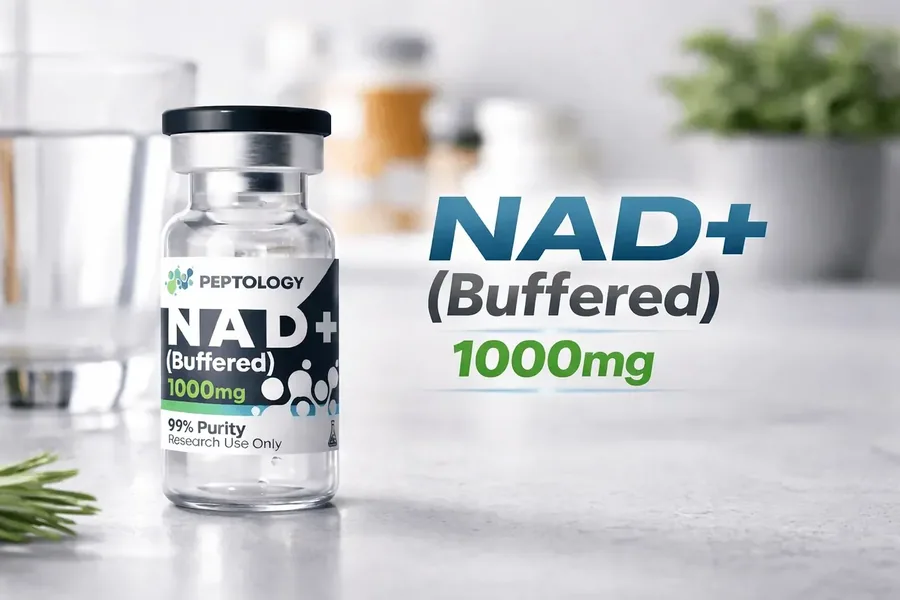
NAD+ 1000 mg from Peptology is supplied as a lyophilised powder in a glass vial, exclusively for laboratory research. The buffered composition keeps the pH of the solution stable, because NAD+ breaks down at extreme pH values, with moisture and with light. Every batch is tested by HPLC (purity) and MS (identity); the certificates of analysis can be found on the Laboratory analyses page.
- Storage: 2–8 °C, protected from direct light (and after reconstitution).
- Reconstitution in the laboratory: with bacteriostatic water; you calculate the concentration (mg/mL) with the reconstitution calculator.
NAD+ 1000 mg for laboratory research
See the price of NAD+ 1000 mg in Cyprus.
See the product at PeptologyFrequently asked questions
What is NAD+?
A coenzyme found in every cell: an electron carrier in metabolism (NAD+/NADH) and a substrate of the sirtuins, the PARPs and CD38.
Is NAD+ a peptide?
No. It is a dinucleotide (coenzyme). In the catalogue it is listed together with peptides studied in cellular metabolism.
What is the difference between NAD+ and NADH?
NAD+ is the oxidised form and NADH the reduced form; the conversion of one into the other transfers electrons to the mitochondrial respiratory chain.
How does NAD+ differ from NMN and NR?
NMN and NR are precursor compounds, which the cell converts into NAD+ through the salvage pathway.
How is NAD+ 1000 mg stored?
At 2–8 °C, away from direct light, and after reconstitution.
Is it intended for human use?
No. NAD+ 1000 mg from Peptology is supplied exclusively for laboratory research and is not intended for human or veterinary use.