🇨🇾 BOX NOW delivery in 5–7 working days ✅ Pay on delivery 📦 Free shipping from €50


MOTS-c
MOTS-c 10/50 mg – 16-amino-acid mitochondrial peptide
Peptology Ltd. · Peptides for energy and regeneration
MOTS-c is a 16-amino-acid mitochondrial peptide that Peptology supplies strictly for laboratory research, in 10/50 mg. You can buy MOTS-c in Cyprus online from €40.00, with same-day dispatch for orders placed by 15:00. 99%+ purity, HPLC/MS certificate for every batch, so every vial comes with documented quality data. Delivery in 5–7 working days with BOX NOW, free from €50; you pay on delivery – by card through the BOX NOW payment link, before you open the locker. The product is not intended for human or veterinary use.
40,00 € · In stock
- 10mg — 40,00 €
- 50mg — 139,00 €
For research use only / Not a medicine
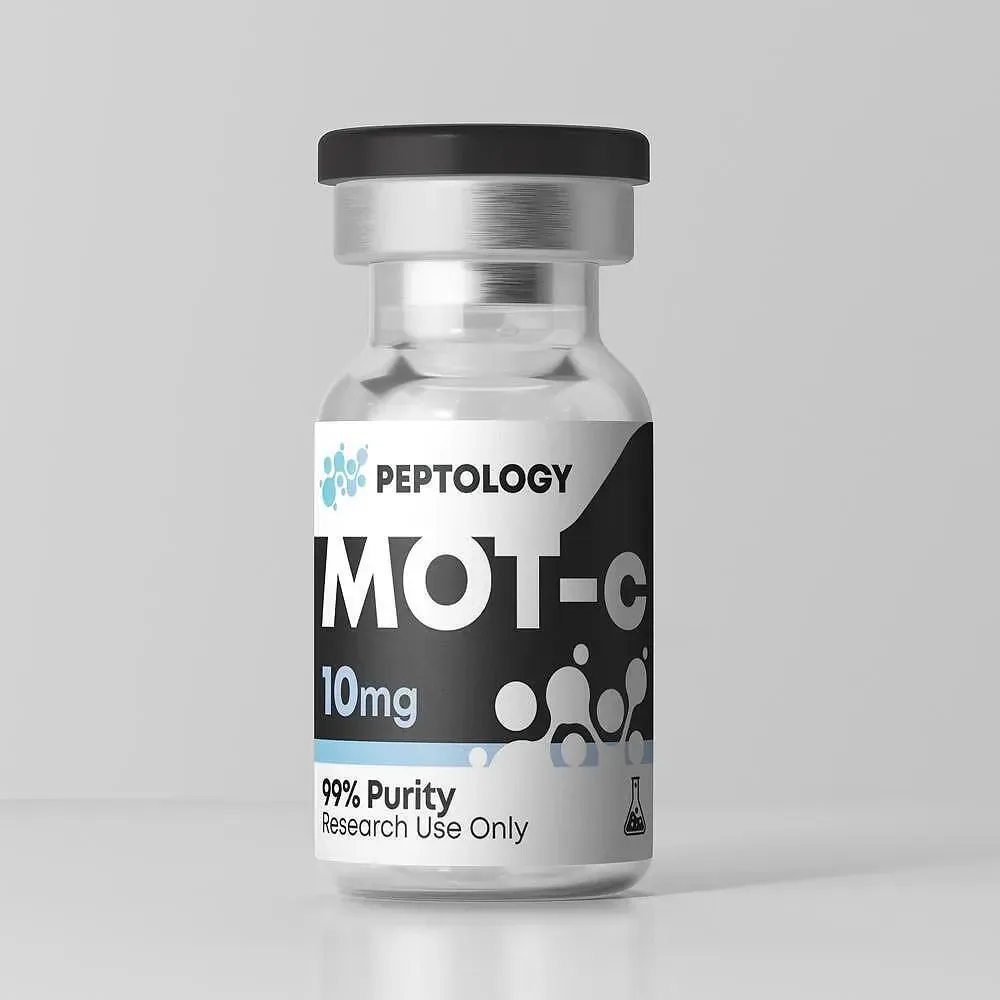
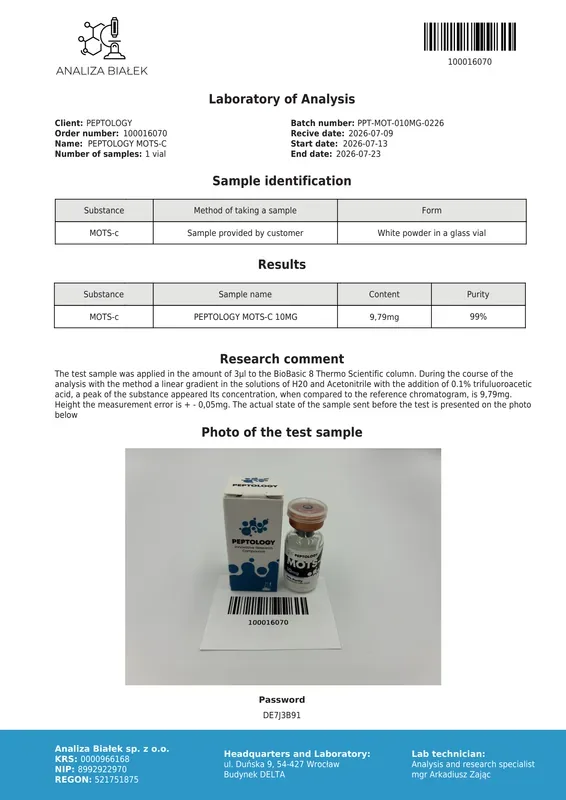
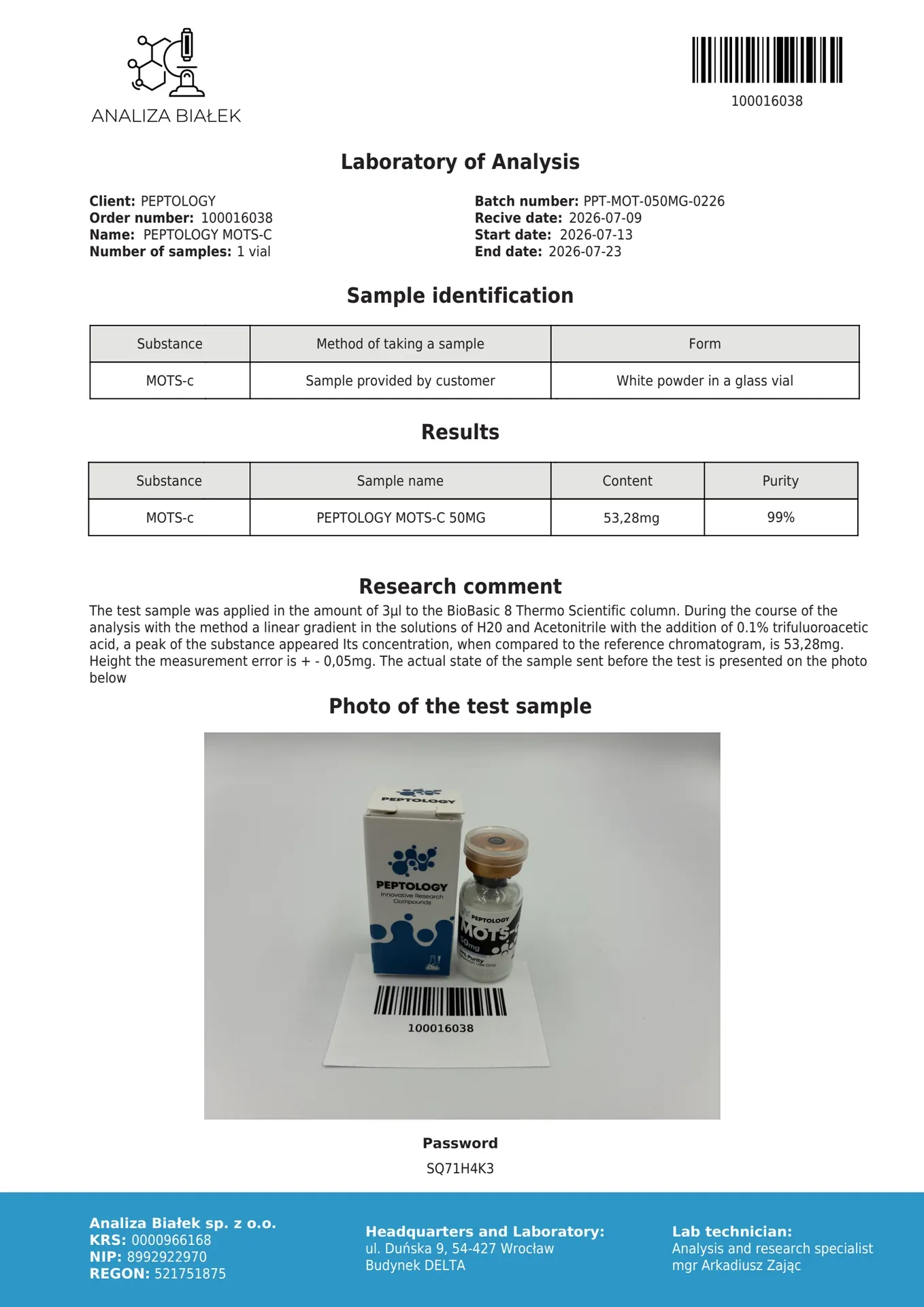
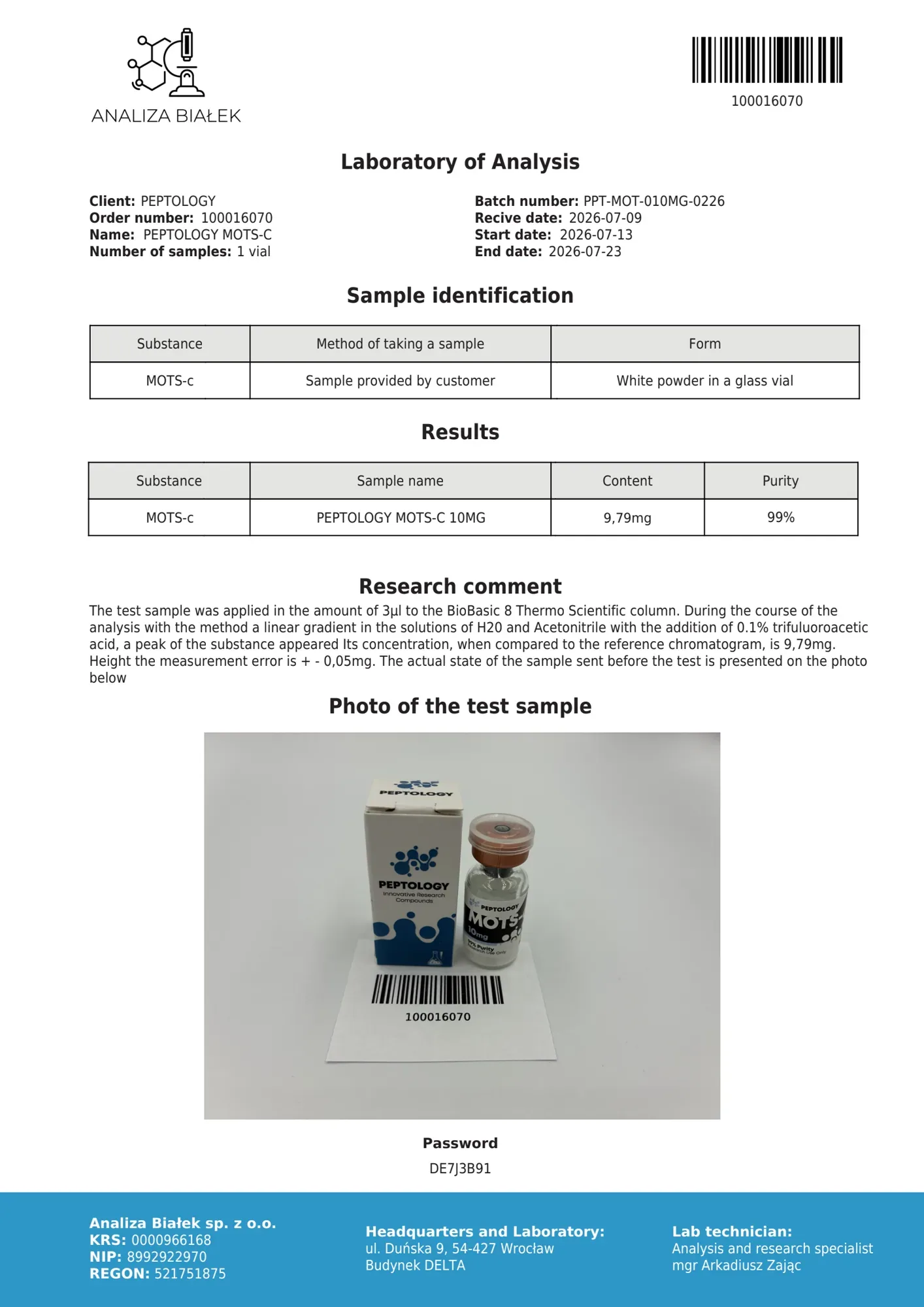
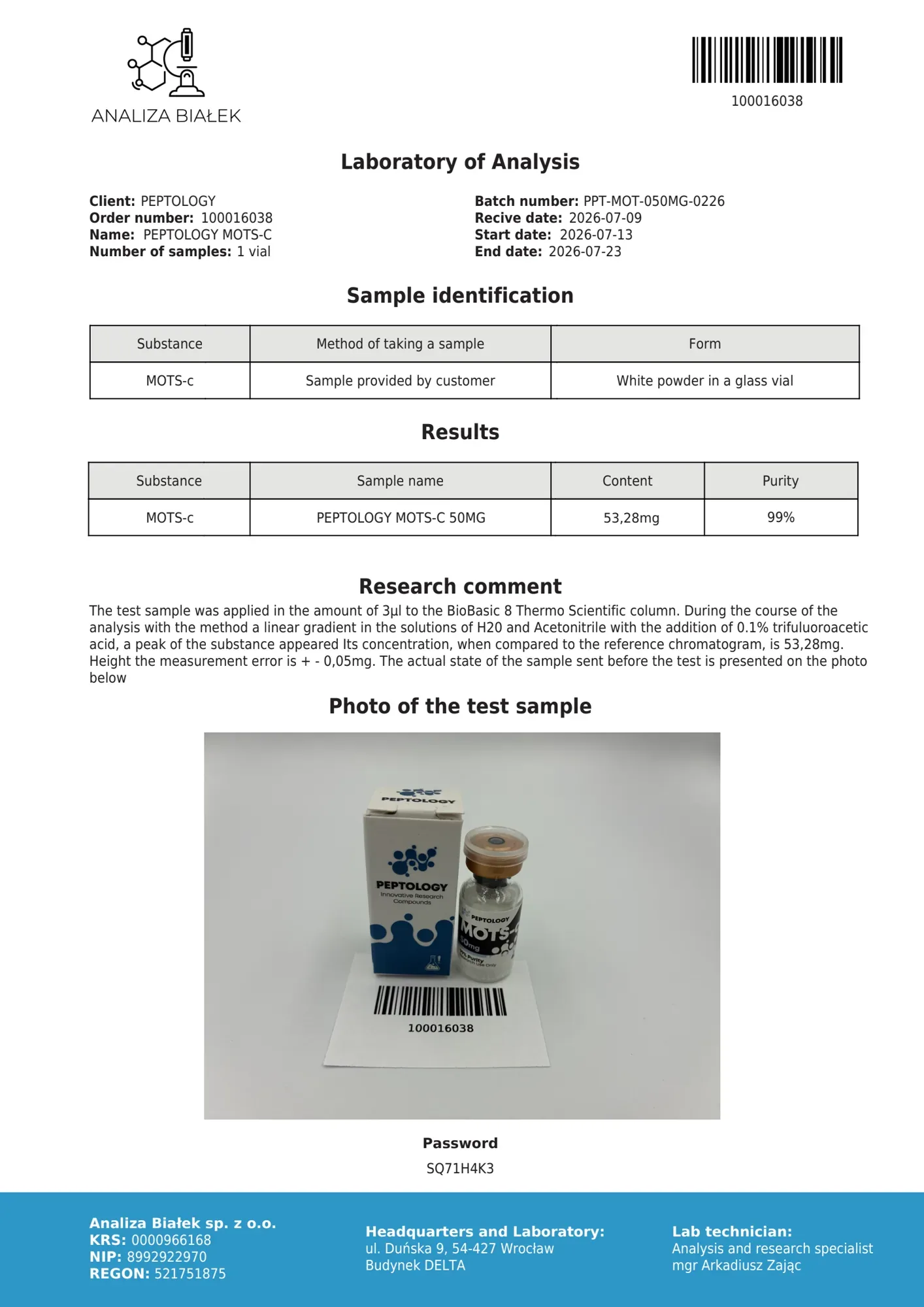
| Purity | >99% |
|---|---|
| Method | HPLC + LC/MS |
| Laboratory | Analiza Białek |
| Batch | 0226 |
Last updated: 18/10/2026
What is MOTS-c?
MOTS-c (Mitochondrial ORF of the 12S rRNA type-c) is a 16-amino-acid mitochondria-derived peptide (MDP) — encoded within the mitochondrial DNA (in the 12S rRNA region), not in the nucleus. It is one of the most studied “mitochondrial signals” that regulate metabolism and adaptation to cellular stress.
Its distinctive characteristic is that it functions as a “communication molecule” between mitochondria and the nucleus: under metabolic stress it moves to the nucleus and regulates the expression of genes related to energy and antioxidant defence. It is often described as an “exercise mimetic”.
It is studied in research for metabolic control, insulin sensitivity, endurance and physical performance, and adaptation to metabolic stress. It works complementarily with other mitochondrial/metabolic molecules such as SS-31 and NAD+. See the range in the category all peptides.
In the Peptology version, it is supplied as a lyophilised research-grade powder with purity > 99%, in two forms — 10 mg and 50 mg. It is intended exclusively for scientific, research and in vitro applications — it is not a medicine or supplement.
Available forms: 10 mg and 50 mg
10 MG
Typical form
For validation experiments and protocols of usual size.
50 MG
Extended form
High content for longer series and extended protocols.
Both forms have purity > 99% and a laboratory certificate for each batch. The choice depends on the scale of the protocol.
How MOTS-c acts — AMPK activation
AMPK PATHWAY
Activates AMPK — the central “energy sensor” of the cell — promoting glucose utilisation and metabolic flexibility.
MITOCHONDRION → NUCLEUS
Under metabolic stress it moves to the nucleus and regulates the expression of genes of the antioxidant and metabolic response.
METABOLIC HOMEOSTASIS
Improves insulin sensitivity and glucose management, with an effect similar to that of exercise.
“Exercise mimetic”
MOTS-c is described as an exercise mimetic because it activates many of the metabolic pathways triggered by physical exercise (mainly via AMPK). In preclinical models it is linked to improved endurance, metabolic flexibility and adaptation to stress — which is why it attracts particular interest in metabolism and ageing research.
Compared with SS-31 (which protects the inner mitochondrial membrane in a targeted way) and NAD+ (a cofactor of energy metabolism), MOTS-c acts as a metabolic regulator/signal. Its levels decline with age. The mechanisms come from preclinical studies.
Properties and pharmacology
- Class: mitochondria-derived peptide (MDP), 16 amino acids
- Origin: encoded in the mitochondrial DNA (12S rRNA region)
- Main pathway: AMPK activation; translocation to the nucleus under stress
- Studied actions: metabolic control, insulin sensitivity, endurance
- Characterisation: “exercise mimetic”; declines with age
- Status: research peptide, not approved for clinical use
MOTS-c vs. SS-31 vs. NAD+
Comparison of three molecules with a central role in mitochondrial function and energy metabolism. Reference data.
| MOTS-c | SS-31 | NAD+ | |
|---|---|---|---|
| Molecule type | Mitochondrial peptide | Peptide | Coenzyme (dinucleotide) |
| Main role | Metabolic regulator | Mitochondrial protection | Energy metabolism |
| Mechanism | AMPK / gene expression | Membrane stabilisation | Enzyme cofactor |
| Characteristic | “Exercise mimetic” | Targeted antioxidant | Energy/redox precursor |
| Status | Research | Research | Research |
Sources: literature on mitochondria-derived peptides and AMPK metabolism.
Research
Metabolism and insulin sensitivity
Preclinical studies have shown that MOTS-c improves insulin sensitivity and glucose homeostasis through the activation of AMPK, with protective effects against metabolic dysfunction in models.
Endurance and adaptation to stress
In experimental models, MOTS-c was linked to improved physical endurance and metabolic adaptation to stress — findings that support its characterisation as an “exercise mimetic”.
Data limitations
The data come mainly from preclinical studies; extensive clinical studies in humans are lacking. MOTS-c remains a research molecule, not approved for clinical use.
Note: Scientific reference based on preclinical data. It is not medical advice or a claim for the product.
In brief — scientific profile
- Mitochondria-derived peptide (16 aa) — encoded in the mitochondrial DNA
- Activates AMPK — the central pathway of metabolic control
- Moves to the nucleus under stress — regulates gene expression
- “Exercise mimetic” — endurance, metabolic flexibility, insulin
- Two forms — 10 mg and 50 mg for different protocol scales
- Research product — not approved for clinical use
Side effects and safety
The safety profile of MOTS-c in humans is not fully characterised, as the data come mainly from preclinical studies. The reactions reported are generally mild.
Common
- Injection-site reactions
- Transient fatigue
- Mild headache
Less common
- Transient glucose changes
- Dizziness
- Mild nausea
Precautions
- Allergic reaction / hypersensitivity
- Caution regarding glucose regulation (diabetes)
- Limited data in humans
Because it affects glucose metabolism, there is a precaution in conditions of glucose regulation. Scientific reference, not an instruction for use.
Related peptides
SS-31
Mitochondrial antioxidant
NAD+ 1000 mg
Energy and redox metabolism
Epithalon
Ageing bioregulator peptide
Peptide Matrix Water™
Recommended reconstitution solvent
See: All peptides · Blog
Research warning: MOTS-c is offered exclusively for scientific, research and in vitro purposes. It is not intended for human/veterinary use, diagnosis, treatment or prevention of any condition and is not medical advice.
Why is it called an “exercise mimetic”?
Because it activates many of the metabolic pathways (mainly AMPK) that are triggered by physical exercise, with effects such as improved endurance and metabolic flexibility in preclinical models.
How does it differ from SS-31?
Both are related to mitochondria. MOTS-c is a metabolic regulator/signal (AMPK, gene expression); SS-31 protects the inner mitochondrial membrane in a targeted way as an antioxidant.
Molecule identity
| CAS number | 1627580-64-6 |
|---|---|
| Molecular weight | 2174.6 g/mol |
| Molecular formula | C101H152N28O22S2 |
| Class | Mitochondrial peptide (16 amino acids) |
| Form | Lyophilised powder in a glass vial |
| Storage | Lyophilisate: 2–8 °C, dry and protected from light · after reconstitution: 2–8 °C |
Buy MOTS-c in Cyprus – price
You can buy MOTS-c in Cyprus online from Peptology. Prices by strength:
- 10mg: €40.00
- 50mg: €139.00
Orders placed by 15:00 on working days ship the same day and are delivered in 5–7 working days with BOX NOW. Shipping costs €2 and is free from €50; you pay on delivery – by card through the BOX NOW payment link, before you open the locker.
MOTS-c 10/50 mg: which strength
MOTS-c is available in: 10/50 mg.
Research protocols
Important: Reference information for research purposes — not a recommendation for use or medical advice.
In the research literature, MOTS-c regimens are shaped around its metabolic/AMPK character:
- It is often studied in repeated administrations per week, in cycles
- Metabolic markers (glucose, insulin sensitivity) are used for monitoring
- It is investigated in combination with physical activity or with other metabolic molecules
It is sometimes studied together with mitochondrial molecules such as SS-31 or NAD+. The regimens come from the literature and are not a recommendation for individual use.
Storage and reconstitution
Supplied as a lyophilised powder in a vial (10 or 50 mg). Lyophilised, it is stable at room temperature, away from light/moisture. For reconstitution, the recommended solvent is Peptide Matrix Water™, which significantly extends the life of the solution.
- Before reconstitution: room temperature, away from light/moisture; up to 24 months.
- With Peptide Matrix Water™ (recommended): refrigerator 2–8 °C up to 60 days — the best stability option.
- With bacteriostatic water or sterile water: refrigerator 2–8 °C up to 28 days. No re-freezing.
- Reconstitution: add the solvent slowly down the wall, without vigorous agitation.
Laboratory tip: Add Peptide Matrix Water™ to your basket — the recommended stabilising solvent for all reconstituted peptides.
Laboratory protocol — reconstitution, research protocols, storage
Standard protocol, applicable to all research peptides in the Peptology catalogue. For the concentration of the solution (mg/mL) per vial, use the peptide reconstitution calculator.
The 60-second protocol
1. SOLVENT
2. RECONSTITUTION
The solvent is added to the wall of the vial, without agitation, then wait 10–15 minutes.
3. CALCULATION
Calculator → concentration in mg/mL
4. STORAGE
+2 °C to +8 °C, up to 60 days with Peptide Matrix Water
Quick reference
| Parameter | Value |
|---|---|
| Form | Lyophilised powder |
| Solvent | Peptide Matrix Water |
| Volume for reconstitution | 1–3 mL — 3 mL maximum (capacity of the standard vial) |
| Storage before reconstitution | Room temperature, protected from direct light (refrigeration is not mandatory) |
| After reconstitution | Up to 60 days at +2 °C to +8 °C with Peptide Matrix Water |
What you will need
Precision pipette
Calibrated, 100–1000 µL — for accurate measurement of the volume of solvent added to the vial.
70% alcohol pads
Two pads — to disinfect the peptide vial and the solvent vial.
Stabilised solvent for lyophilised peptides. Why this one.
Five rules for reconstitution
| ✅ Correct | ❌ Wrong |
|---|---|
| Disinfect the stoppers and the work surface with 70% alcohol, work with gloves | Working without disinfection |
| The solvent is added slowly down the wall of the vial | Direct jet onto the powder — foaming and denaturation |
| Light swirling between the palms | Shaking — foam, on which the peptides denature |
| Wait 10–15 minutes at room temperature | Mechanical mixing or heating |
| Visual inspection: clear, without particles | Using a cloudy or coloured solution |
Calculating the concentration
⚠️ Maximum 3 mL of solvent. The standard vial does not allow a larger volume — do not exceed it during reconstitution.
- Concentration (mg/mL) = mg in the vial ÷ mL of solvent
- Volume per sample (mL) = amount per sample (mg) ÷ concentration (mg/mL)
- 1 mg/mL = 1 µg/µL · 1 mL = 1000 µL
Reconstitution per vial — solvent: Peptide Matrix Water. Concentration after addition (1 mg/mL = 1 µg/µL):
| Vial | + 1 mL | + 2 mL | + 3 mL |
|---|---|---|---|
| 10 mg | 10 mg/mL | 5 mg/mL | 3.33 mg/mL |
| 50 mg | 50 mg/mL | 25 mg/mL | 16.67 mg/mL |
👉 For any vial and solvent volume — use the calculator. It calculates the concentration (mg/mL, µg/µL) and the volume per sample (mL, µL).
Storage
BEFORE RECONSTITUTION
Room temperature, protected from direct light, in the original packaging. Refrigeration is not mandatory.
AFTER RECONSTITUTION
+2 °C to +8 °C, up to 60 days with Peptide Matrix Water. Discard the remainder after this period.
FREEZING
Not recommended. Freeze/thaw cycles degrade the structure of the peptide.
Four mistakes to avoid
1. Shaking for “faster dissolution”
Foam = denaturation. Only gentle swirling between the palms.
2. Unsuitable solvent
For the stability of the peptide structure, use only a sterile, purpose-designed solvent — Peptide Matrix Water is recommended.
3. Ignoring slight cloudiness
If it is not completely clear = the sample does not meet the criteria for work.
4. Removing it from the refrigerator “for an hour or two”
Short exposures add up and jeopardise stability.
Research status: All Peptology products are intended exclusively for laboratory use and research. They are not pharmaceutical products, have not been approved for human or veterinary use and do not replace medical advice. The protocol described is standard laboratory practice for working with lyophilised peptides.
How is it stored?
The lyophilised vial is stored at room temperature, away from light. After reconstitution: with Peptide Matrix Water™ — up to 60 days at 2–8 °C; with bacteriostatic water — up to 28 days.
Purity and certificate of analysis
99%+ purity, HPLC/MS certificate for every batch.
MOTS-c - 10 mg - Batch - 0226 - Purity

MOTS-c - 50 mg - Batch - 0226 - Purity

Shipping and payment
Orders placed by 15:00 on working days ship the same day and are delivered in 5–7 working days with BOX NOW. Shipping costs €2 and is free from €50; you pay on delivery – by card through the BOX NOW payment link, before you open the locker.
🚚 Delivery information
- Orders placed by 15:00 are dispatched the same day, delivery in 5–7 working days.
-
Shipping with BOX NOW, chosen at checkout. Free shipping from €50, otherwise €2.
Frequently asked questions about MOTS-c
Where can I buy MOTS-c in Cyprus and what does it cost?
In Cyprus you can buy MOTS-c online from Peptology, from €40.00 (10mg: €40.00, 50mg: €139.00). Delivery in 5–7 working days with BOX NOW, free from €50; you pay on delivery – by card through the BOX NOW payment link, before you open the locker.
What is MOTS-c?
It is a 16-amino-acid mitochondria-derived peptide, encoded in the mitochondrial DNA. It activates AMPK and regulates metabolism, insulin sensitivity and adaptation to cellular stress.
In what form is MOTS-c available?
As a lyophilised powder in a glass vial (10/50 mg). It is reconstituted in the laboratory with Peptide Matrix Water™ or bacteriostatic water; you can work out the concentration (mg/mL) with the <a href="/page/peptide-calculator">reconstitution calculator</a>.
Which side effects have been reported in clinical studies of MOTS-c?
The safety profile of MOTS-c in humans is not fully characterised, as the data come mainly from preclinical studies. The reactions reported are generally mild.
How long does delivery take and how do I pay?
Orders placed by 15:00 on working days ship the same day and are delivered in 5–7 working days with BOX NOW. Shipping costs €2 and is free from €50; you pay on delivery – by card through the BOX NOW payment link, before you open the locker.