
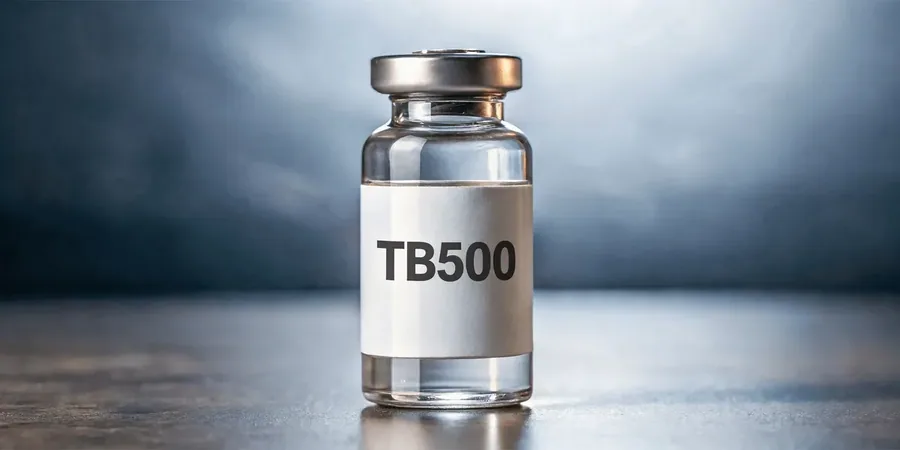
TB-500 – a high-efficacy peptide for regeneration and repair: what it is, how it acts, benefits, risks, combinations and its place in “Recovery and anabolic peptides”
What it is, how it acts, benefits, risks, comparisons and its place in “Recovery and anabolic peptides”.
Summary in brief
TB-500 is a synthetic peptide, an analogue of thymosin beta-4 (Tβ4). It acts on actin dynamics, cell migration and angiogenesis, and has anti-inflammatory effects. In preclinical models it supports healing, tendon/ligament regeneration, cardioprotection and neuroregeneration. A product for research use, not for human use.
What TB-500 is and how it differs from Tβ4
Tβ4 (~43 AA) is endogenous and regulates F-actin. TB-500 was developed to reproduce its regenerative domains with better stability in the laboratory. Tβ4 is endogenous, TB-500 is for research; both are evaluated mainly with preclinical/early clinical data, without approved indications.
Mechanism of action – why “actin” is at the centre
- Binding of G-actin → regulation of the cytoskeleton, faster migration.
- Angiogenesis → VEGF pathways and capillary neovascularisation.
- Anti-inflammatory action → limiting of infiltration/cytokines.
- Cytoprotection in cardio/neuro models.
Thus TB-500 fits more into “recovery & regeneration” than into “pure anabolism”.
Possible benefits (research context)
- Wound healing & epithelial regeneration (faster re-epithelialisation).
- Tendons/ligaments/fasciae: better collagen organisation & mechanical properties.
- Muscle recovery after mechanical stress, possible synergy with training & protein.
- Cardioprotection in animal models (smaller ischaemic zone, better capillary networking).
- Neuroregeneration/neuroprotection in experimental models.
The benefits derive from preclinical/early studies; there are no approved indications.
TB-500 in the context of “Recovery and anabolic peptides”
The category includes GH–IGF-1 modulators, “downstream” agents (IGF-1) and redox support. TB-500 is a regenerative peptide, complementary to “pulsatile” strategies (e.g. CJC-1295 without DAC + Ipamorelin) and to Glutathione.
Comparison: TB-500 vs. BPC-157
- Focus: TB-500 – migration/angiogenesis; BPC-157 – GI tract/tendons/vascular protection.
- Tissues: TB-500 – endothelium/epithelium; BPC-157 – tendons/ligaments/GI tract.
- Combination: possible complementarity in research protocols.
- Human data: no approved indications for either.
Benefits & limitations – what the literature shows
- Skin/cornea: faster re-epithelialisation, increased angiogenesis.
- Orthopaedics/sports medicine: better matrix organisation & mechanical properties.
- Cardio/neuro: reduced necrosis, improved perfusion, neuroprotection.
Limitations: heterogeneous designs, small samples, lack of standardised endpoints; need for robust RCTs.
Possible combinations (educational)
- TB-500 + BPC-157 – complementary mechanisms for soft tissues/tendons/epithelium.
- TB-500 + CJC-1295 without DAC + Ipamorelin – pulsatile GH (sleep, SWS) + migration/angiogenesis.
- TB-500 + Glutathione – reduction of oxidative stress under high load.
- TB-500 + collagen/amino acids – an essential substrate for tissue reconstruction.
When it is NOT used / caution
- Active/unclarified neoplasms – theoretical mitogenic pressure.
- Serious cardiometabolic conditions, unmonitored dysglycaemia, active infections.
- Pregnancy/lactation; minors.
- Allergies/hypersensitivity to excipients/solvents.
- Athletes: see WADA.
- Regulatory: product for research use – not for human use.
Practical notes
- Lyophilised vs. liquid: the lyophilised form is more conservative; after reconstitution the “clock” starts ticking.
- Timing: synchronisation with sleep and low mechanical stress.
- Monitoring: local reactions, fluid retention, headache; subjective markers of sleep/recovery.
- Nutrition/hydration/trace elements: sufficiency of amino acids & electrolytes.
TB-500 vs. “classic anabolics”
TB-500 does not directly increase IGF-1 and is not an “anabolic” of the classic type. Strength: regenerative biology (cell migration/angiogenesis). Complementary with CJC-1295 without DAC + Ipamorelin, Glutathione, protein/collagen/vitamin C and a proper training plan.
Risks & adverse effects
- Local reactions: pain/erythema; rarely inflammation.
- Fluid retention/oedema, headache, dizziness.
- Theoretical oncological concerns with prolonged exposure.
- Regulatory/anti-doping risks (WADA).
Who would choose TB-500 (for research)
- Wound healing & epithelial regeneration (skin, cornea).
- Orthopaedic models (tendon/ligament) with migration/collagen limitations.
- Studies of angiogenesis/endothelium and anti-inflammatory mechanisms.
- Cardio/neuro experiments (cytoprotection & recovery, preclinical).
Internal links
External sources
FAQ
Does TB-500 replace sleep, nutrition and training?
No. It is a regeneration regulator. Without sleep, protein/collagen and structured training, the result is limited.
Is it stronger than BPC-157?
Different and often complementary: TB-500 – angiogenesis/migration; BPC-157 – GI tract/tendons/vascular protection.
Suitable for athletes?
No. Agents of this class are prohibited by WADA in competition.
Are there data in humans?
Limited/early, with no approved indications. Most of the data are preclinical.
Conclusion
TB-500 is a research peptide with a solid biological rationale (cell migration, angiogenesis, anti-inflammatory action), with preclinical benefits in healing/regeneration. In the context of “Recovery and anabolic peptides” it complements pulsatile GH strategies and redox control. Given the regulatory/anti-doping profile and the limited human data, the approach must be conservative, ethically/regulatorily safeguarded and always based on the fundamentals: sleep, nutrition, training, safety.