
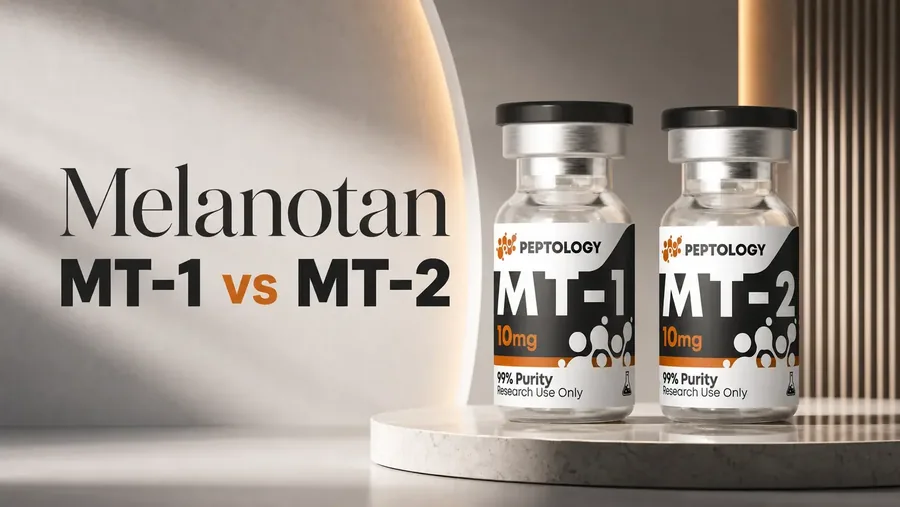
MT-1 vs. MT-2: Which Melanotan peptide to choose for tanning, and what is the difference
An in-depth comparative analysis of the two best-known pigmentation peptides – Melanotan I and Melanotan II. We examine the mechanism, the similarities and differences, the safety profile and when the choice of one or the other is scientifically justified.
Natural tanning is the result of a complex biological process controlled by the melanocortin system. When the skin is exposed to ultraviolet light, the body releases melanocyte-stimulating hormone (α-MSH), which activates receptors on the surface of melanocytes and triggers the synthesis of melanin – the natural photoprotective pigment. The two synthetic peptides MT-1 (Melanotan I) and MT-2 (Melanotan II) were created precisely to reproduce and enhance this mechanism, inducing pigmentation without intense sun exposure. Although their names are almost identical, the two molecules differ substantially in structure, receptor selectivity and action profile. This article clarifies the differences, to help researchers make an informed choice.
1. What is MT-1 (Melanotan I / Afamelanotide)
MT-1 (also known as Melanotan I, Afamelanotide, NDP-MSH, [Nle4, D-Phe7]-α-MSH) is a synthetic linear peptide of 13 amino acids, an analogue of natural α-MSH. The two amino acid substitutions (Nle at position 4 and D-Phe at position 7) give it greater potency and stability compared with the natural hormone. In the clinical literature, MT-1 is described as a selective agonist of melanocortin receptor 1 (MC1R), meaning that its action is concentrated mainly on melanogenesis and photoprotection.
The most important distinguishing feature of MT-1 is its regulatory history. Afamelanotide was approved by the EMA in 2014 and by the FDA in October 2019 as a 16 mg controlled-release subcutaneous implant for the treatment of erythropoietic protoporphyria (EPP) – a rare disease in which patients experience intense pain on exposure to light. This makes MT-1 the first approved melanocortin agonist for photoprotection. The version offered by Peptology is a lyophilised research peptide with purity above 99%, confirmed by independent laboratory analysis – it is not an approved medicine, but a material intended exclusively for scientific, research and in vitro applications.
2. What is MT-2 (Melanotan II)
MT-2 (Melanotan II, MT-II, Melanotan 2 acetate) is a synthetic cyclic peptide of 7 amino acids, with the sequence Ac-Nle-c[Asp-His-D-Phe-Arg-Trp-Lys]-NH₂. Unlike MT-1, this molecule is a pan-melanocortin agonist – it activates the MC1R, MC3R, MC4R and MC5R receptors simultaneously. It is precisely this broad activity that explains both its stronger melanogenic action and its additional effects on libido and appetite, which are mediated by MC4R.
MT-2 was developed in the late 1980s at the University of Arizona, by the team of Victor J. Hruby and Mac Hadley. The original idea was innovative: to create a synthetic agonist capable of inducing skin darkening without UV exposure, with the potential to prevent skin cancer in high-risk individuals. Unlike MT-1, however, MT-2 never went through a full regulatory programme and remains an unapproved drug in all jurisdictions. Regulatory authorities in several countries (FDA, UK MHRA, Scandinavian bodies) have issued explicit warnings about its unregulated use. In the Peptology catalogue, MT-2 is offered as a lyophilised research peptide with purity above 99%, exclusively for scientific and research purposes.
3. Mechanism: selectivity vs. broad action
There are five melanocortin receptors (MC1R–MC5R) and they control different functions – pigmentation (MC1R), steroidogenesis (MC2R), energy balance and libido (MC3R/MC4R). The main difference between the two peptides lies precisely in the receptors they bind to:
MT-1 – focused on MC1R
MT-1 binds selectively to melanocortin receptor 1 on melanocytes, activating cAMP and the transcription factor MITF, which induces tyrosinase – the key enzyme for eumelanin synthesis. The result is an action concentrated on pigmentation, with less pronounced central effects (libido, appetite).
MT-2 – broad-spectrum
MT-2 activates all melanocortin receptors with high affinity. This means a stronger and faster melanogenic action, but also significant additional effects – increased libido and spontaneous erections (via MC4R), reduced appetite (also MC4R), and a broader profile of adverse effects.
In other words, both peptides stimulate eumelanin – the brownish-black, photoprotective pigment of the skin – but MT-1 does so with “surgical” precision, while MT-2 activates the whole melanocortin system at once. This selectivity is the reason why the more “clean” derivatives PT-141 (Bremelanotide) – for libido, and afamelanotide (MT-1) – for photoprotection, were rationally developed from MT-2.
4. Table: MT-1 vs. MT-2 – full comparison
| Characteristic | MT-1 (Melanotan I) | MT-2 (Melanotan II) |
|---|---|---|
| Structure | Linear peptide (13 aa) | Cyclic peptide (7 aa, ~1024 Da) |
| Receptor selectivity | Selective for MC1R | Pan-melanocortin (MC1R/MC3R/MC4R/MC5R) |
| Main action | Pigmentation & photoprotection | Pigmentation + libido + appetite ↓ |
| Tanning intensity | Moderate, gradual | Strong, faster |
| Side effects | Less pronounced (focused profile) | Broader (nausea, erections, darkening of moles) |
| Half-life (SC) | More stable than α-MSH | ~30–60 minutes |
| Regulatory status | FDA/EMA approved for EPP | Unapproved / research |
| Time to visible tan | First changes after 3–5 administrations | First changes after 5–7 days |
The data are provided as a scientific reference and are based on the published literature on afamelanotide and MT-II. They are not a direct “one-to-one” clinical comparison, nor a claim about the effect of the research product.
5. Similarities between the two peptides
Despite the differences, MT-1 and MT-2 share a common origin and a number of characteristics. Both derive from natural α-MSH and belong to the class of melanocortin agonists. Both stimulate the production of eumelanin and can induce pigmentation without the need for intense UV exposure – although moderate sun exposure enhances the effect in both. Both are administered subcutaneously, are offered as a lyophilised powder with purity above 99%, and belong to the Peptides for skin, sleep and libido category in the Peptology catalogue. Both require dermatological monitoring of moles and skin lesions because of their effect on pigmentation, and neither is offered as an approved product for human use – both are research peptides.
6. Advantages and disadvantages
- Selective MC1R agonist – focused on pigmentation and photoprotection.
- FDA/EMA approved for EPP – well-documented profile.
- Fewer central side effects (libido, appetite, nausea).
- Particularly suitable for light phototypes (I–II), with controlled pigmentation.
- Available to buy at Peptology, with independent laboratory analysis.
- Stronger and faster melanogenic action – more intense tan.
- Additional effects on libido and appetite (an advantage for certain studies).
- Unapproved drug – regulatory warnings in many countries.
- Broader profile of adverse effects: nausea, flushing, spontaneous erections.
- Higher risk of darkening of moles and uneven tanning – requires strict monitoring.
7. Which one when: how to choose the right peptide
The choice between the two peptides depends entirely on the goal of the research and the sensitivity profile:
When MT-1 is more suitable: when the emphasis is on pure pigmentation and photoprotection, without accompanying central effects. MT-1 is the logical choice for studies in light phototypes (I–II), for melanogenesis models with a more predictable, gradual profile, and when looking for a molecule with established regulatory and scientific validation. Because of its weaker effects on libido and appetite, it is the “cleaner” choice when these effects are not desired.
When MT-2 is more suitable: when a stronger and faster melanogenic action is sought, or when the study deliberately also covers the effects mediated by MC4R – libido and appetite. MT-2 is the historic “broad-spectrum” molecule, covering the entire melanocortin profile in one compound. It does, however, require more careful dosing and stricter dermatological monitoring.
An important clarification: combining the two peptides is not recommended, as they have different receptor profiles and are usually studied separately. If the main goal is libido rather than tanning, the more focused choice is PT-141 (Bremelanotide), which is optimised precisely for MC4R.
8. Safety and melanoma risk
Both peptides affect pigmentation, which makes monitoring of skin lesions a standard precaution. Their safety profiles nevertheless differ because of the difference in receptor selectivity.
MT-1 – favourable profile
In the clinical studies of afamelanotide, the safety profile is described as favourable. Commonly reported reactions: injection-site reactions, headache, nausea, darkening of the skin and moles. Dermatological monitoring of naevi is recommended.
MT-2 – broader profile
MT-2 has a significant and broad profile of adverse effects: almost universal nausea in the loading phase, flushing, spontaneous erections, reduced appetite, darkening of existing moles and the appearance of new pigmented lesions.
The most critical parameter for MT-2 is the risk of melanoma. Cases of atypical transformation of moles in MT-2 users have been published in the dermatological literature. A direct cause-and-effect relationship has not yet been definitively documented, but the theoretical mechanism is scientifically plausible. People with a personal or family history of melanoma, with multiple atypical naevi or with a light phototype should avoid MT-2. This information is a scientific reference and does not constitute instructions for use in humans.
9. Reconstitution and storage protocol
Both peptides are supplied as a lyophilised powder and require precise reconstitution for reliable experimental results:
- Solvent: use a high-quality stabilising solvent – Peptide Matrix Water™ from the Peptide Solutions category is recommended. Inject the liquid slowly, onto the wall of the vial, so that the integrity of the lyophilised powder is not affected.
- No shaking: never shake the vial vigorously – foam denatures the peptide. Use gentle swirling movements until completely clear.
- Storage after reconstitution: at 2°C to 8°C – up to 60 days with Peptide Matrix Water™. Avoid direct light and re-freezing. For MT-2, storage frozen (−20°C) before reconstitution is recommended, for long-term stability.
- Dose calculation: for exact IU in any vial and volume, use the peptide reconstitution calculator.
Choose the right Melanotan peptide for your research
Both peptides are offered with purity above 99% and independent laboratory analysis per batch, with discreet delivery in Cyprus within 5–7 working days. See the prices and buy online.
See MT-1 and MT-2 at Peptology10. Conclusion
MT-1 and MT-2 derive from the same hormone and pursue the same end goal – inducing natural pigmentation – but they achieve it in fundamentally different ways. MT-1 (Melanotan I) is the selective, regulatorily validated molecule focused on pure photoprotection and a more predictable profile, particularly suitable for light phototypes. MT-2 (Melanotan II) is the original broad-spectrum molecule, with a stronger tan, but also with a broader profile of side effects and more serious safety parameters. The right choice depends on the research goal, the phototype and the acceptable risk profile. At Peptology we strive to offer excellent quality and transparent prices for all your research projects in the field of the melanocortin system and pigmentation.