🇨🇾 BOX NOW delivery in 5–7 working days ✅ Pay on delivery 📦 Free shipping from €50

Semaglutide: Science, Results and Clinical Trials
Semaglutide is a GLP-1 receptor agonist – a modified peptide that stimulates glucose-dependent insulin secretion, suppresses glucagon, delays gastric emptying and reduces appetite.
Semaglutide: Science, Results and Clinical Trials
Peptology · 2026-06-04

What is semaglutide?
Semaglutide is a GLP-1 receptor agonist – a modified peptide that stimulates glucose-dependent insulin secretion, suppresses glucagon, delays gastric emptying and reduces appetite.
Because of its long half-life (~175 hours), it is administered once a week under the skin.
The largest and longest-running semaglutide (2.4 mg) trial: the SELECT trial
Overview
-
The most extensive, long-term study on the safety and efficacy of semaglutide 2.4 mg administered weekly.
-
Participants: 17,604 overweight adults with established cardiovascular disease, without diabetes.
-
Duration: follow-up of up to 4 years (≈208 weeks).
Main results
Reduction in cardiovascular events (MACE)
-
Semaglutide reduced the risk of major adverse cardiovascular events (cardiovascular death, non-fatal myocardial infarction or stroke) by 20% (6.5% versus 8.0%; HR 0.80; 95% CI 0.72–0.90; P<0.001) compared with placebo.
Continued weight loss
-
Mean weight loss was tracked for up to 4 years, remaining consistently above the difference from placebo. All demographic groups showed significant results.
Safety and tolerability
-
Gastrointestinal adverse events: more common with semaglutide (RR ~1.47); low rates of discontinuation due to side effects.
-
Serious adverse events: low rate (~9%) in both the semaglutide group and the placebo group.
-
After treatment discontinuation, weight regain is significant.
In all subgroups
-
The result is consistent regardless of sex, race, BMI or glycaemic status.
Summary of this Phase III/IV programme
|
Category |
Result |
|---|---|
|
Number of participants |
17.604 |
|
Follow-up |
Up to 4 years |
|
Weight loss |
Stable means above 4 g at 2.4 mg |
|
Reduction in MACE risk |
–20% (HR 0.80) |
|
Adverse events |
Gastrointestinal symptoms common, but a small % of serious events |
|
Discontinuation |
Regain on discontinuation |
Why this programme matters:
-
It surpasses all other randomised controlled trial programmes (STEP trials) in size and duration and, as such, provides the strongest basis for assessing long-term safety and sustained effect.
-
The SELECT study reflects real patients with chronic heart disease but without diabetes, demonstrating the benefits of semaglutide even in the absence of diabetic disease.
Clinical data: STEP programmes
STEP 1 (68 weeks)
Includes 1,961 adults with BMI ≥ 30 or ≥ 27 with comorbidity, without diabetes. Dose 2.4 mg once a week + behavioural therapy.
Mean weight loss: −14.9% with semaglutide versus −2.4% with placebo (difference −12.4%).
Loss ≥ 5%: 86.6% of the active group versus 47.6% of the placebo group.
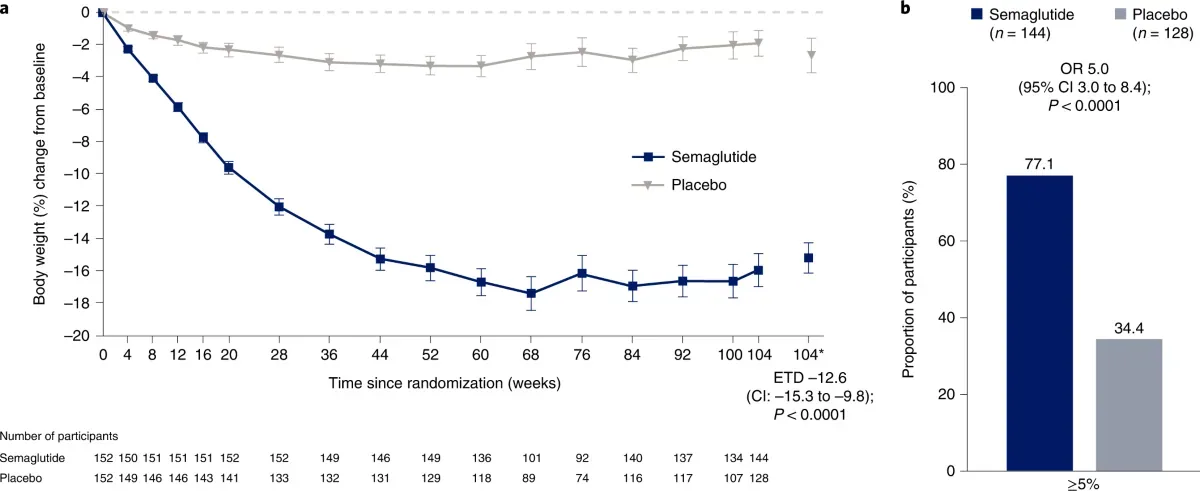
STEP 5 (104 weeks)
Continuation of the STEP trials – mean weight loss 15.2% up to week 104. 44.2% achieved weight loss ≥10%, 11% ≥15%, 4.9% ≥25% from baseline.
The study recorded minimal weight regain between weeks 52 and 104.
STEP UP (7.2 mg dose)
New study (72 weeks) with 1,407 participants:
Mean weight loss: 20.7% (7.2 mg) versus 17.5% (2.4 mg) and 2.4% (placebo). 33.2% achieved weight loss ≥25%. 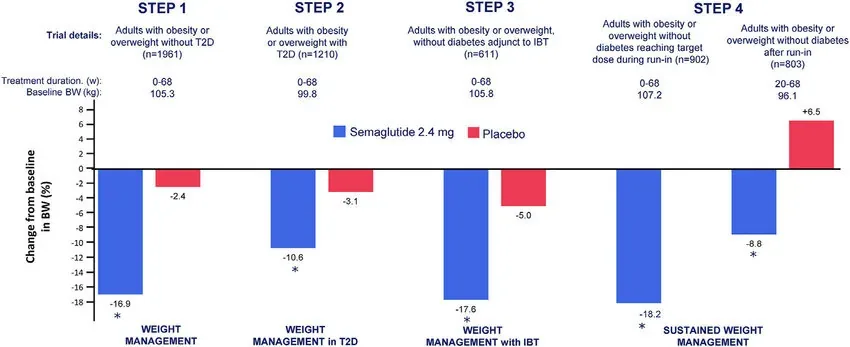
Real-world practice: Cohort analysis
The cohort study includes 175 patients:
Weight loss: 5.9% after 3 months, 10.9% after 6 months, according to data from randomised controlled trials.
Systematic review (science)
One study summarises data from multiple randomised controlled trials: in the studies semaglutide reduced weight, improved HbA1c, blood pressure and lipids and was associated with a reduction in MACE risk, with the effect not depending solely on the amount of weight loss.
Safety and side effects
-
The most common adverse events – nausea, vomiting, diarrhoea, constipation.
-
Serious warnings: possible risk of pancreatitis, gallstones and a rare risk in patients with medullary thyroid carcinoma or MEN2 syndrome.
-
After treatment discontinuation – risk of weight regain: participants lost 17.3% on average over 68 weeks, but regained about 11.6% by week 120 after stopping treatment.
-
Real-world conditions – in cohort studies with mass use, only ~50% of patients remain on the full dose for 1 year, the mean weight loss is around 6.9% due to early discontinuation or low doses, but with a stable dose and maintenance, the results resemble data from randomised controlled trials (~15–18%).
-
Muscle mass risk – the studies also recorded loss of lean muscle mass.
Other research data
-
Semaglutide demonstrates anti-inflammatory action, independent of weight: it affects MASLD, metabolic inflammation and cellular regulation in animal models and patients .
-
New studies show possible benefits in patients with type 1 diabetes and obesity: improved glycaemic control and weight loss among those using semaglutide plus insulin without an increased risk of hypoglycaemia. , although additional large randomised controlled trials are needed.
Peptology offers Semaglutide exclusively for laboratory research, with an HPLC/MS certificate for every batch. See price and purchase of Semaglutide.