🇨🇾 BOX NOW delivery in 5–7 working days ✅ Pay on delivery 📦 Free shipping from €50

Epithalon 50 mg: telomerase, cellular renewal and the biological clock
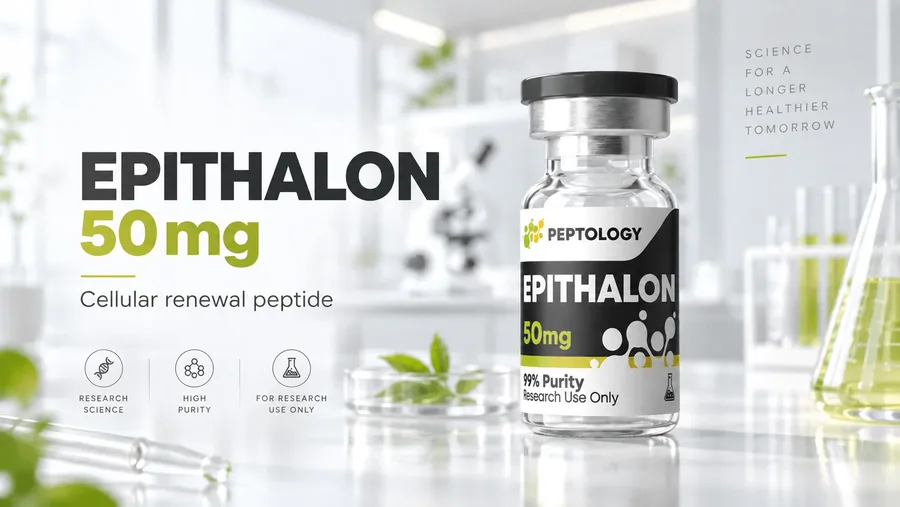
In the search for the molecules hiding behind ageing, few names provoke as much interest as Epithalon (also known as Epitalon or AEDG). This synthetic tetrapeptide has become one of the most-studied compounds in the field of peptide bioregulation and cellular longevity. Epithalon 50 mg from Peptology is supplied as a lyophilised powder with purity above 99%, intended exclusively for laboratory and research purposes.
Epithalon 50 mg: telomerase, cellular renewal and the biological clock
Peptology · 2026-09-11
Scientific publication · Longevity and biohacking
In the search for the molecules hiding behind ageing, few names provoke as much interest as Epithalon (also known as Epitalon or AEDG). This synthetic tetrapeptide has become one of the most-studied compounds in the field of peptide bioregulation and cellular longevity. Epithalon 50 mg from Peptology is supplied as a lyophilised powder with purity above 99%, intended exclusively for laboratory and research purposes.
In this overview we examine what Epithalon is, how it is supposed to act on telomerase and telomeres, what its connection is with the pineal gland and sleep, which product category it belongs to, what it is combined with and how it is correctly reconstituted and stored.
- 1. What is Epithalon (AEDG)?
- 2. Mechanism of action: telomerase and telomeres
- 3. Main benefits studied scientifically
- 4. Category: Peptides for skin, sleep and libido
- 5. The pineal gland, melatonin and circadian rhythms
- 6. Synergy: what Epithalon is combined with
- 7. Advantages and disadvantages
- 8. Comparison: Epithalon vs other anti-aging approaches
- 9. Reconstitution and storage instructions
- 10. Conclusion
- 11. Sources and scientific literature
1. What is Epithalon (AEDG)?
Epithalon is a synthetic tetrapeptide with the sequence Ala-Glu-Asp-Gly (alanine–glutamic acid–aspartic acid–glycine), abbreviated AEDG. It was synthesised as a shorter, standardised analogue of the natural polypeptide extract epithalamin, obtained from the pineal gland (epiphysis).
Its development is the work of the Russian school of gerontology associated with Professor Vladimir Khavinson and the Saint Petersburg Institute of Bioregulation and Gerontology. It is precisely within the framework of the concept of peptide bioregulators that Epithalon became a model for studying the question of whether short peptides can “switch on” certain genes and influence cellular renewal. Thanks to its small size, the molecule is stable, easy to synthesise and convenient for laboratory protocols.
The idea behind peptide bioregulators is that the organism has short, tissue-specific peptides that function as signals for maintaining normal organ function. With age, these signals weaken. The hypothesis is that introducing the corresponding synthetic peptide may “remind” the cells of their original way of functioning. For Epithalon, the target tissue is the pineal gland, while the wider research interest turns toward telomere biology – a crossroads that makes this molecule unusually interesting compared with most individual peptides.
2. Mechanism of action: telomerase and telomeres
The central hypothesis around Epithalon is linked to the enzyme telomerase. With every cell division, the protective “caps” at the ends of the chromosomes – the telomeres – become shorter. When they reach a critical length, the cell stops dividing and enters a state of senescence (replicative senescence, the so-called “Hayflick limit”). Telomerase is the enzyme that can rebuild telomeres.
The Hayflick limit
In the early 1960s, Leonard Hayflick found that normal human cells can divide only a certain number of times before they stop irreversibly. This limit, known as the Hayflick limit, is due precisely to the gradual shortening of telomeres. The role of telomerase was clarified later – an enzyme active in stem and germ cells, but suppressed in most somatic cells. This is exactly why the possibility that a short peptide could reactivate this enzyme provokes such great research interest.
In experiments with human somatic cells in culture it was observed that AEDG induces telomerase activity and telomere elongation, allowing the cells to exceed the usual limit on divisions – some publications report an increase in replicative capacity of about 42%.
Epigenetic regulation
Unlike gene therapy, Epithalon is not permanently integrated into the genome. It is thought to act epigenetically: it binds to certain regions of DNA and regulates which genes are active at a given moment – including the gene of the catalytic subunit of telomerase (hTERT). This “gentle” mechanism of regulation is also the reason why the effects are considered reversible and dependent on continued application, rather than a one-off irreversible change.
3. Main benefits studied scientifically
In the scientific literature on Epithalon, several main directions of interest emerge:
- Cellular renewal and telomeres – telomerase activation and telomere elongation in cell models.
- Regulation of the pineal gland – restoration of the normal rhythm of melatonin secretion, particularly in ageing models.
- Circadian rhythms and sleep – normalisation of the sleep–wake cycle through the pineal axis.
- Antioxidant and geroprotective action – observations of reduced oxidative stress and effects on ageing markers in animal experiments.
- Regulation of gene expression – as a peptide bioregulator, Epithalon is studied for its ability to influence the activity of certain genes.
It is precisely this combination – simultaneous action on the telomere axis and on the pineal/circadian axis – that makes Epithalon a preferred subject for researchers interested in longevity biohacking, the mechanisms of biological ageing and the relationship between sleep and cellular health.
4. Category: Peptides for skin, sleep and libido
Epithalon belongs to the Peptology category Peptides for skin, sleep and libido. This category brings together compounds whose research profiles intersect on three axes of quality of life: skin regeneration, sleep quality and hormonal and libido balance. Here Epithalon finds its natural place – through its connection with the pineal gland and melatonin it is examined mainly in terms of sleep and circadian rhythms, while its action on telomerase links it to the theme of cellular renewal and “anti-aging”.
If you are exploring this field more widely, in the same category you will also find complementary peptides – for example copper peptides for skin and hair, as well as compounds oriented towards libido and hormonal regulation. See the whole category Peptides for skin, sleep and libido to compare the different mechanisms in the context of your specific research question.
5. The pineal gland, melatonin and circadian rhythms
The pineal gland is a small endocrine structure in the brain that synthesises melatonin – the key hormone of sleep and the internal clock. With age, melatonin secretion decreases and its rhythm is disturbed, which is often linked with poorer sleep quality and disruption of circadian rhythms.
Because Epithalon derives conceptually from epithalamin (a pineal extract), an important part of the research on it focuses on the restoration of pineal function. In animal models, normalisation of the nocturnal peak of melatonin and of the sleep–wake cycle has been reported. It is precisely this axis – pineal gland → melatonin → sleep – that is the reason why Epithalon is classed in the sleep category and not only as a “telomerase” peptide.
The importance of this mechanism goes beyond the subjective sense of “good sleep”. Melatonin is both a powerful antioxidant and a regulator of many daily biological processes – from metabolism to immune function. That is why the hypothesis that Epithalon may maintain a stable circadian rhythm is considered a possible bridge between sleep quality and broader markers of cellular ageing. In longevity research, disturbed circadian rhythms are considered an independent risk factor and not merely a symptom of ageing.
6. Synergy: what Epithalon is combined with
In research protocols, Epithalon is often examined in combination with other compounds whose mechanisms complement it:
- NAD+ and precursors – for cellular energy, DNA repair and mitochondrial support, as a complement to the telomere axis.
- SS-31 (Elamipretide) – a mitochondrial peptide that targets the energy metabolism of the cell.
- Copper peptides (GHK-Cu, AHK-Cu) – when the focus also includes skin and hair regeneration.
- Peptide Matrix Water™ – not as an active ingredient, but as a stabilising medium for reconstitution.
A combination must always follow a carefully designed research design – different peptides have different stability windows and storage conditions.
7. Advantages and disadvantages
Advantages
- A small, stable and well-characterised molecule (AEDG).
- A rich research base in the field of telomerase and pineal regulation.
- A targeted mechanism – telomeres and circadian rhythms simultaneously.
- High purity (>99%) and convenient dosing in a 50 mg vial.
Disadvantages
- Limited data in humans; lack of large clinical studies.
- Requires reconstitution and storage in the refrigerator after dissolution.
- Applied in short repeated cycles, not continuously.
- Intended exclusively for research purposes.
8. Comparison: Epithalon vs other anti-aging approaches
| Characteristic | Epithalon (AEDG) | NAD+ (Buffered) | GHK-Cu |
|---|---|---|---|
| Main axis | Telomeres and pineal/sleep axis | Cellular energy and DNA repair | Skin and matrix regeneration |
| Molecule type | Tetrapeptide | Coenzyme | Copper tripeptide |
| Key mechanism | Telomerase activation, gene expression | Restoration of NAD+ levels | Signalling to fibroblasts |
| Research focus | Longevity, sleep, circadian rhythms | Metabolism, energy | Skin, hair, healing |
| Category | Skin, sleep and libido | Cellular energy and regeneration | Skin, sleep and libido |
The three compounds are not interchangeable; rather, they illuminate different aspects of cellular ageing – telomere length, energy status and tissue regeneration.
9. Reconstitution and storage instructions
Epithalon is supplied as a lyophilised (dried) powder that must be reconstituted before use in a research protocol:
- Recommended medium: Peptide Matrix Water™ – ensures stability for up to ~60 days at 2–8 °C.
- Alternative: bacteriostatic or sterile water (stability for up to ~28 days).
- Method: add the solvent slowly to the wall of the vial; mix by gentle swirling – do not shake.
- Storage: before reconstitution – at room temperature, protected from light; after reconstitution – in the refrigerator at 2–8 °C.
- Regimen: short repeated cycles, not continuous daily application.
A typical research design
In the published protocols, Epithalon is usually studied in cycles – short periods of application separated by breaks, during which the relevant markers are monitored. Such a pulsatile model is considered closer to natural peptide signalling than the constant presence of the substance. When designing a study it is good to define in advance: the measurement points, the way of keeping the reconstituted solution within its stability window, and the conditions of protection from light and heat. Using a dosing calculator helps with the accurate and repeatable preparation of the solution.
Ready to explore cellular renewal?
Epithalon 50 mg with purity above 99% – from Peptology.
See the product at Peptology10. Conclusion
Epithalon (AEDG) is one of the most emblematic peptide bioregulators of modern longevity science. The combination of action on telomerase, regulation of the pineal gland and influence on circadian rhythms makes it a particularly interesting subject for the study of cellular renewal and sleep quality. At the same time, it is important to take a sober approach: much of the data comes from cell and animal models, while the data in humans still remain to be deepened. As part of the category Peptides for skin, sleep and libido, Epithalon remains a valuable tool for any well-structured research protocol aimed at biohacking and cell optimisation.
11. Sources and scientific literature
- Khavinson VKh, et al. “Peptide promotes overcoming of the division limit in human somatic cells.” Bull Exp Biol Med – PubMed
- Khavinson VKh, Bondarev IE, Butyugov AA. “Epithalon peptide induces telomerase activity and telomere elongation in human somatic cells.” Bull Exp Biol Med, 2003 – PubMed
- Anisimov VN, Khavinson VKh, et al. “Effect of Epitalon on aging biomarkers, life span and tumor incidence.” – PubMed
- Korkushko OV, Khavinson VKh, Shatilo VB. “Peptide geroprotector: long-term clinical observations.” Bull Exp Biol Med, 2011 – PubMed
The content is informational and scientific in nature. Epithalon is intended exclusively for research purposes (Research Use Only) and is not a medicinal product, dietary supplement or product for human or veterinary use.