

Glutathione (GSH): the “master” antioxidant, mechanism of action, stability and safety profile
A specialised overview of glutathione: GSH↔GSSG, GPx/GR/GST, mitochondrial protection, detoxification conjugations and good stability practices. The information is based on published research and data.
- A key intracellular antioxidant: a tripeptide (γ-glutamyl-cysteinyl-glycine); the GSH:GSSG ratio is important.
- Enzyme systems: GPx/GR for the redox cycle; GST for conjugations (phase II).
- Lyophilised = conservative choice: more stable logistics/storage; after reconstitution – protection from light/metals.
- Good tolerability: the data show a favourable profile; product for research use.
1) What is glutathione?
Glutathione is a tripeptide made of L-glutamate, L-cysteine and glycine. In cells the reduced form GSH predominates, which neutralises ROS and electrophiles; the oxidised form GSSG arises after reactions with peroxides/radicals. The GSH:GSSG ratio is an established indicator of the intracellular redox status.
2) How it acts: GSH↔GSSG and enzymes
- Glutathione peroxidase (GPx): reduces peroxides using GSH → GSSG.
- Glutathione reductase (GR): restores GSSG to GSH (NADPH-dependent).
- Glutathione S-transferases (GST): conjugate GSH to electrophilic substrates (phase II), facilitating excretion.
- γ-Glutamyl cycle (GGT): transport and re-synthesis of glutathione.
- Mitochondrial GSH: protection of mitochondrial membranes/enzymes from peroxide damage.
3) GSH structure and conversion to GSSG (what the image shows)
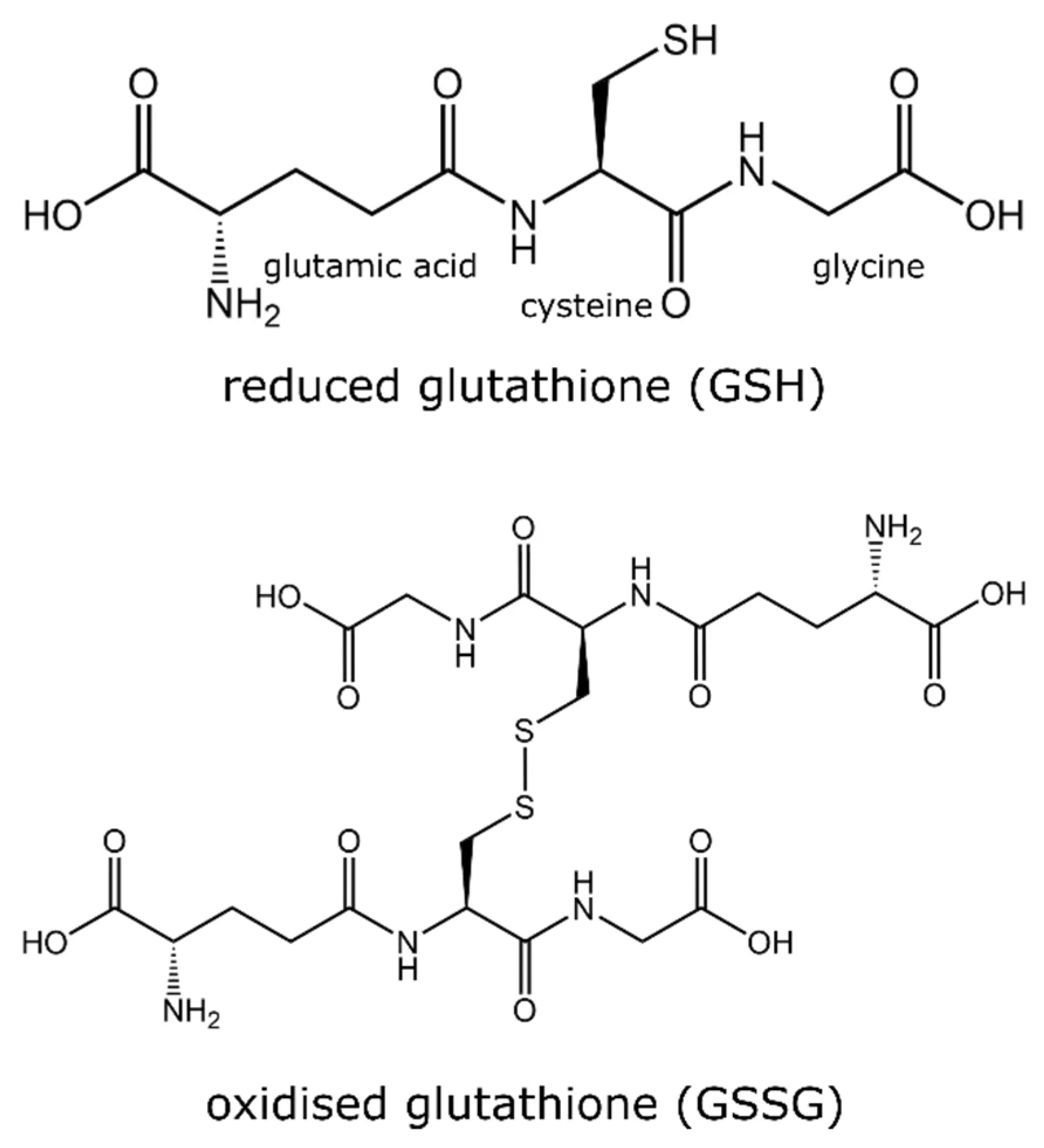
Glutathione (GSH) is a tripeptide (glutamate–cysteine–glycine) with a γ-glutamyl bond between glutamate and cysteine. The thiol group (–SH) of cysteine donates electrons to peroxides and radicals.
On oxidation, two GSH molecules form a disulphide bridge (–S–S–) and GSSG results. The GSH↔GSSG pair is regulated by enzymes:
- GPx: 2 GSH + ROOH → GSSG + ROH + H2O
- GR: GSSG + NADPH + H+ → 2 GSH + NADP+
A high GSH:GSSG ratio indicates a reducing, protective environment against lipid peroxidation. The thiol group (pKa ~8.5–9) requires suitable buffers and strict pH control in the protocols.
4) Main research directions
- Oxidative stress and ageing: GSH regulates ROS; its effect on homeostasis and recovery is being studied.
- Hepatic biotransformation: GSH-dependent conjugations (GST) – the core of phase II.
- Immunomodulation/redox signalling: interaction with the Nrf2 axis and anti-inflammatory pathways.
- Skin/pigmentation: effects on tyrosinase and melanogenesis in research models.
- Neuro-redox: protection of vulnerable lipid membranes from lipid peroxidation.
5) Forms, stability and reconstitution (lyophilised)
Lyophilised glutathione offers better tolerance to logistical fluctuations. After reconstitution:
- Store at 2–8 °C and protect from light.
- Minimise contact with air; work quickly and cleanly.
- Avoid metal ions that catalyse oxidation.
- Define the concentration (mg/mL) and note the date/time.
Good practices: validated solvent/buffer, SOP for “in-use” deadlines, traceability per batch.
6) Glutathione vs precursors
Precursors (e.g. L-cysteine/NAC) support the endogenous synthesis of GSH; direct GSH provides control of the immediate concentration in the model system. The choice depends on the experiment’s goals (rapid redox effect vs long-term support) and the model.
7) Safety profile
- Tolerability: generally favourable in the literature; possible mild local events.
- Methodological risks: oxidative degradation with unsuitable storage/exposure.
- Good practices: aseptic conditions, cold chain, proper packaging, CoA and traceability.
- Important: product for research use, not intended for human use.
8) Supplier checklist
- CoA (HPLC/LC-MS) for the specific batch.
- Stability data and “in-use” instructions.
- Packaging/logistics: insulated box, cool packs, temperature logging.
- Reconstitution instructions and concentration suggestions.
- Traceability: batch, reconstitution date, usage log.
9) FAQ
Is glutathione a “medicine”?
No. The product is for research use and is not intended for human use.
How do I minimise oxidation after reconstitution?
Work at low temperature and in darkness, minimise contact with air, avoid metals and observe “in-use” deadlines.
Does combining with other antioxidant systems make sense?
In research applications, combined redox networks are often studied; the design depends on the model and the goal.
10) Sources
- Peptology – Glutathione 1500 mg (Detox/Antioxidant)
- Forman HJ et al. – Glutathione in cellular redox homeostasis (review)
- Wu G et al. – Glutathione metabolism and implications (review)
- Townsend DM et al. – The importance of glutathione (review)
- Hayes JD et al. – GST and detoxication (review)
- Richie JP Jr. et al. – Glutathione status trial
- PubMed – search: “GSH GSSG ratio review”